
GEORGETOWN, Guyana, Sept 14, CMC – The Caribbean Community (CARICOM) appointed Eminent Persons Group (EPG) has ended an eight day visit to Haiti observing “several positive developments” as the French-speaking country continues preparations for elections in December this year, according to a statement issued here on Monday.
The CARICOM Secretariat said that the EPG chaired by former St. Lucia prime minister Dr. Kenny Anthony and including former Jamaican prime minister Bruce Golding and their Bahamian counterpart, Perry Christie, had visited the country from September 2-9.
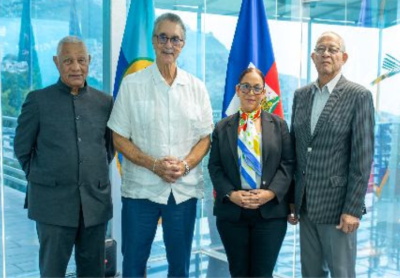 It said that the group held discussions with a large number, and broad range of political and civil society stakeholders including the business community, youth, women and human rights organisations; key government institutions; and the leadership of the Gang Suppression Force (GSF).
“The visit of the EPG also provided a timely opportunity to assess the political conjuncture and to engage in dialogue on the preparations for the first round of elections scheduled for 13 December 2026.
“The EPG observed several positive developments, including the work being undertaken to reignite an election process after more than ten years. The EPG noted that political parties were in various stages of preparation to participate in the forthcoming elections, including by forming political groupings,” according to the CARICOM Secretariat statement.
The first round of long-awaited presidential and legislative elections, alongside a constitutional referendum are scheduled for December 13, marking the first time Haitians will be casting ballots since 2016 when President Jovenel Moise was elected. Moise was later assassinated on July 7,2021.
The preliminary results are expected to be published December 19, with final results for the first round scheduled for January 9, 2027. A second round of presidential and legislative elections, along with local elections, is scheduled for February 21, 2027 with final results for the second round of presidential and legislative elections scheduled for March 7, with final local election results expected March 12.
Last Friday, the Secretary General of the Organization of American States (OAS) Albert Ramdin told a news conference has held several conversations with the EPG on the issue of politicians in Haiti linked with criminal gangs.
“I have had several conversations with the EPG not only about this matter, but also the impediments to elections,” he said, noting that “only a couple of days ago” he held talks with Anthony and in the “coming week I will be talking to the EPG once they complete their mission in Haiti.
“I think the EPG does valuable work to connect with political organisations, and as such gets information, but also understands where they stand in the political realm of developments in Haiti. It is a very difficult situation.
“It is not easy to organise elections after 10 years, and certainly not under the conditions when many parts of Haiti are controlled by gangs, and that is something which needs to be addressed.”
The CARICOM Secretariat statement said that stakeholders in Haiti have also expressed their views and concerns on the new measures required by the amended Electoral Decree.
“They claimed that many of these measures were unwieldy and onerous. They were particularly concerned by the number of documents candidates were required to provide to the Electoral Council (CEP) and the slow pace of the registration of electors.
“ It was drawn to the attention of the EPG that the voter registration process was not meeting expectations. The process was constricted by the existence of territories beyond state control. Many of the stakeholders emphasized the need for greater public sensitisation on the process and wider availability of registration centres.
The statement said that though striving to comply with the demands required to participate in the elections, a number of parties called for the modification of some of the procedures and requirements that might necessitate a deferment of the December 13 election date.
“Stakeholders however expressed a yearning for fair, credible, impartial and inclusive elections to bring an end to the successive transitional arrangements that have been an unwelcome feature of the multidimensional crisis in Haiti.”
The statement said that the security situation remains of particular concern and that the “EPG noted the recent spread and spike in deadly violence and kidnappings, as well as the challenges contributing to the slow deployment of the GSF (Gang Suppression Force)”.
The GSF is a United Nations Security Council-backed multinational security mission deployed to Haiti to dismantle armed gangs and restore public order within an initial 12-month mandate. It is authorised for up to 5,550 police and military personnel.
“In their discussions, all stakeholders underscored the critical importance of ensuring a security environment that will allow for country-wide registration of voters, political campaigning, freedom of movement and for citizens to vote safely.
“Deployment of the additional forces and resources pledged by various countries and strategic operational coordination among these and the Haitian security forces are of paramount importance in achieving this objective,” the CARICOM Secretariat statement noted.
“Haiti is at a critical juncture. With important steps being taken by Haitians towards stability and a return to democratic governance in their country, the EPG calls on international partners to refocus efforts to deliver with despatch on security commitments made to ensure the implementation of UN Security Council Resolution 2793,” the statement added.
CMC/gt/ir/2026