
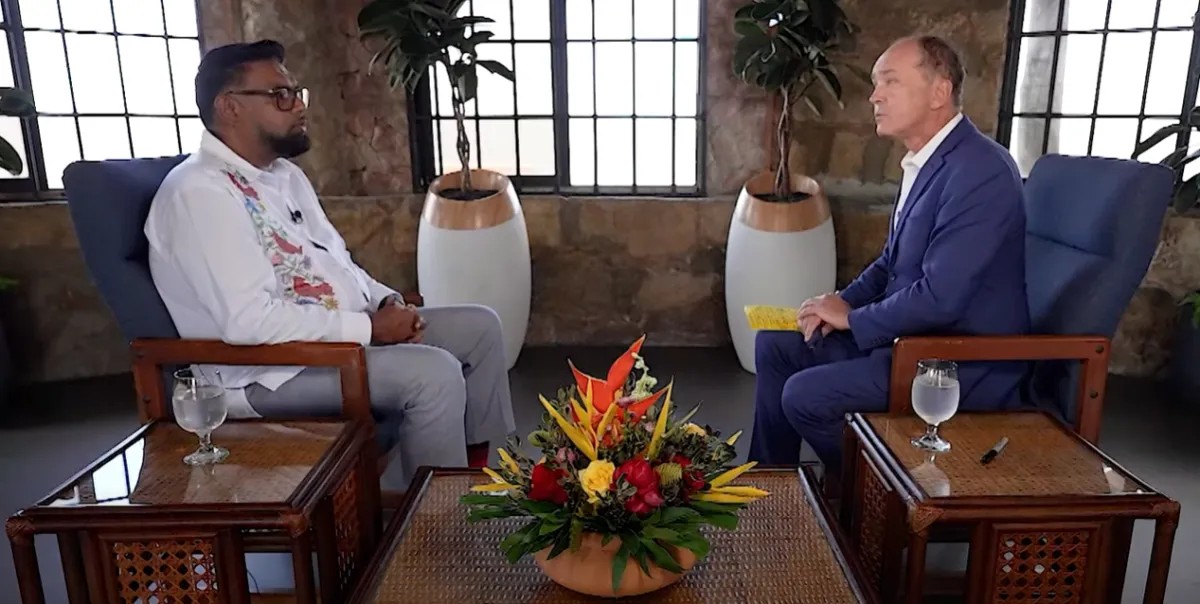
GEORGETOWN, Guyana, Oct 22, CMC – President Irfaan Ali is calling for a comprehensive reparations framework that addresses the lasting developmental inequalities caused by slavery, including through concessional financing, debt relief and targeted investment, rather than direct monetary compensation.
Ali made the proposal during an interview with Robert Moore of ITV News ahead of the October 29-30 visit to Guyana by King Charles III and Queen Camilla, which will mark 60 years of diplomatic relations between Guyana and the United Kingdom.
He said the legacy of slavery must be addressed through meaningful international dialogue, with Guyana working alongside the Caribbean Community (CARICOM), the African Union (AU) and other partners to advance reparative justice.
Describing slavery as one of humanity’s greatest injustices, Ali said recognition of its atrocities must be accompanied by practical measures to address the long-term consequences for countries whose development had been disrupted.
“You can never create a monetary mechanism to address that, but what you can do is to identify the development gaps, the development inequality, the underdevelopment that took place as a result of slavery,” Ali said.
He proposed that discussions consider preferential development financing, debt relief and targeted investment in education, healthcare, mental health, climate adaptation and mitigation.
Ali said these measures should recognise the structural disadvantages inherited by countries affected by slavery and help them close development gaps and compete more effectively in the global economy.
He also addressed calls for an apology from the British monarchy, noting that King Charles had described slavery as the darkest days of British history and expressed regret over that period.
While acknowledging the significance of that recognition, Ali said a formal apology would help create an environment for constructive dialogue and further action.
“Now, moving to the apology is the next step,” he said, expressing hope that discussions among Commonwealth leaders would produce an agreed approach to advancing reparations.
Ali stressed that the issue should be pursued collectively, rather than by Guyana alone, given the shared history and consequences of slavery across the Caribbean and other affected regions.
He also credited King Charles with helping to draw international attention to tropical forests and climate change, including through his association with Guyana’s Iwokrama rainforest conservation initiative.
During their visit, the King and Queen are expected to meet Ali at State House and engage with Indigenous leaders, members of the British business community, young scientists and environmentalists. They are also expected to participate in activities related to rainforest conservation and sustainable cities.
The visit will be King Charles’s first to Guyana as reigning monarch. His mother, Queen Elizabeth II, visited the country in 1994.
CMC/ed/2026