
GEORGETOWN, Guyana, Jul 28, CMC – A war of words has broken out between the Attorney General Chambers and a sitting High Court judge, with the Attorney General, Anil Nandlall saying his failure to respond to “such infelicitous remarks on the public record without repudiation is simply not an option”.
In a four-page statement released here on Saturday night, Nandlall described as “unfortunate” the “intemperate sentiment” expressed by Justice Gino Persaud in respect of certain written submissions made by a team of lawyers from the Attorney General’s Chambers, which he led.
He said the statements by the judge “have regrettably wound themselves into the public domain” and as a result “I am obliged to respond”.
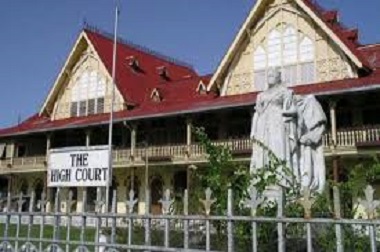 Last week, the High Court judge was critical of the Attorney General for saying that if the court had recognised an arbitral award that monies owed to Venezuela and its state-owned oil company, PDVSA, were to be released to American oil company, ConocoPhillips, whose assets had been nationalised by the Venezuelan government, this would be anti-nationalist tantamount to potential interference in Guyana’s judiciary.
The High Court had earlier found that ConocoPhillips had successfully registered and enforced the same award in the United Kingdom, United States, Hong Kong, Jamaica, Trinidad, the Netherlands and Portugal and no lawful reason was established as to why it should not be registered and enforced in Guyana.
The Respondents did not appear to contest it. But after the High Court issues the order, the respondents have 42 days to apply for it to be set aside.
“The notions submitted by the AG in writing at paragraphs 69 and 71 of his submissions that if I were to recognise the award it would be wholly offensive and expose the Court in the minds of the Guyanese people to allegations of unpatriotic and anti-nationalist conduct is an offensive submission if not a veiled threat to the independence of the judiciary designed to intimidate the Court,” Justice Persaud said in his judgement.
The 2022 Report of the Auditor General states that “(a) ccording to the Bank of Guyana Statement of Account, the opening balance on this account as at 1 January 2022 was G$5.344 billion or US$25.632 million while the closing balance as at 31 December 2022 was G$6.674 billion or US$32.011 million, an increase of G$1.33 billion or USD$6.379 million.”
On 17 January 2018, the Ministry of Finance requested the Bank of Guyana to open an interest-bearing US Dollar bank account to set aside all payments due, and which cannot be made to Venezuela. This account has been established in Switzerland at the Bank for International Settlements (BIS) and has been credited with all obligations payable to Venezuela.
After the Venezuelan government nationalized the assets of ConocoPhillips, the American oil company took PDVSA to arbitration and won a huge award. ConocoPhillips then sought to enforce the award against PDVSA in countries where they had assets.
Guyana under the Petrocaribe agreement has money holding for PDVSA and Venezuela under the repayment of the loans under Petrocaribe.
Justice Persaud in being critical of Nandlall’s position, said not even a lawyer just out of Law School should resort to level such accusations against a judge more so as part of a written submission.
“The AG is not the legal guardian of the minds of the Guyanese people. It is an opportunistic political argument perhaps best suited to the hustings of an elections campaign than a sound legal argument suitable for Court.
“It is most unfortunate, disrespectful and should have been withdrawn. No practitioner (whether a novitiate recently admitted to the Bar or the Leader of the Bar) should ever accuse a sitting judge of unpatriotic and anti-nationalist conduct moreover to reduce it into writing, said Justice Persaud, a former human rights and transparency advocate.
The judge said the right to enforce an arbitral award at common law is well established and arises from the implied promise to pay the award that emanates from the arbitration agreement.
He said the Jamaica Supreme Court appointed a Receiver in 2021 to collect funds owed by the government of Jamaica to PDVSA in relation to the PetroCaribe arrangement between Venezuela and Jamaica and so far, approximately US$22 million has been collected and used towards satisfaction of the award.
Justice Persaud cautioned that Guyana as a premier destination for investment and the world’s fastest growing economy would not augur well for the country’s image and reputation in the eyes of international corporate titans who may be willing to do business here that international arbitral awards are problematic to recognise, register and enforce in Guyana.
“To counter such negative perceptions, it is imperative more than ever that a strong and independent judiciary be capable of fairly and impartially pronounc[e] on such enforcement applications with predictability which the commercial world takes comfort in.
“The Judiciary cannot be timorous in the face of impassioned opposition by the State to deny recognition and enforcement because to do so would be “offensive, unpatriotic and anti-nationalist,” Justice persaud added.
But in his response, Nandlall said judges are bound to conduct themselves on the Bench, judiciously, whatever the conduct with which they are confronted.
“It is for this reason that the majesty of the law in its wisdom imbues them with the exceptional power of contempt “in the face of the Court”. Even in the exercise of this rare power, they are enjoined to do so with a level of calm and sobriety befitting the venerated office which they hold,” he said in the statement.
Nandlall, said Justice Persaud “opined that our written submissions conveyed a “veiled threat” to the independence of the Judiciary.
“I reject this interpretation absolutely. The learned Judge expressed some other injudicious ad hominem and disparaging remarks directed to the Office of the Attorney General to which if I am to respond, would cause the learned Judge to descend further. As a result, I exercise due restraint.”
He said in reflecting upon this matter, he is reminded of the “sagacious admonitions” of a former chief justice of India, speaking on the conduct of judges on the Bench, noted “we may observe in conclusion that judges should not use strong and carping language while criticising the conduct of parties or their witnesses.
“They must act with sobriety, moderation and restraint. They must have the humility to recognise that they are not infallible and any harsh and disparaging strictures passed by them against any party may be mistaken and unjustified and if so, they may do considerable harm and mischief and result in injustice.”
Nandlall sought to put the current controversy in context “for the benefit of the reading public,” saying a foreign company filed certain proceedings to register a foreign Arbitral Award in the High Court of Guyana obtained against two Venezuelan State-owned corporations.
“The clear objective is to enforce the Arbitral Award against monies which the foreign company believes are held by the Government of Guyana as debts to the Bolivarian Republic of Venezuela”.
Nandlall said that the Arbitration Act of Guyana provides for objection to the registration of such an award on the ground that its enforcement would be contrary to the public policy of Guyana.
“Having regard to our current relations with Venezuela and the imposition by the United States of sanctions against the Government of Venezuela, and in particular, one of the companies named in the Arbitral Award, we are of the considered view that it would be contrary to the public policy of Guyana to have the said Award registered and enforced in Guyana.”
The Attorney General said that in the state’s submissions “we detailed our current border controversy with Venezuela, making copious references to the bellicose threats of invasion, the Venezuelan Referendum, etc. and the continuous misuse by Venezuela of innocent occurrences to accuse Guyana of acting proactively, escalating tensions and of provoking a response from Venezuela.
“We made reference to the International Court of Justice (ICJ) Interim Order which prohibits both parties from taking any action which might aggravate or extend the dispute before the Court. We also placed before the Court the Argyle Declaration in which the Presidents of both countries committed not to take steps that will tensions or aggravate the controversy.
“Against that backdrop, we submitted that it would clearly be injurious to the public interest to facilitate the enforcement of this Award in Guyan,” Nandlall said in his four-page statement.
“We further submitted that the two other arms of the Government of Guyana – the Executive and the National Assembly (the Legislature) – have already pledged their unreserved support for Guyana to take a united position on this matter,” he said, adding that this position is reflected in Resolution No. 66, which was debated and passed unanimously in the National Assembly on 6 November last year.
“We argued that this Resolution expresses the mandate of the citizens of Guyana through their elected representatives in accordance with Article 9 of the Constitution.
“We submitted that “it is a justifiable apprehension that if the judicial arm is to extend its processes to be used to allow a foreign company to garnish or levy upon Venezuelan property held by Guyana, such an act will be interpreted, or is capable of being interpreted, as an act of aggression against Venezuela, and an act, if not violative of the letter, would certainly be violative of the spirit, of both the Argyle Declaration and the ICJ’s Interim Measures. In short, it would therefore be patently injurious to the national interest and public policy of Guyana for this Honourable Court to lend its jurisdiction to such a process.”
Nandlall said that the state also examined the various case law authorities that evaluated what in law would constitute public policy and its violations.
The Attorney General said lawyers by their very oath are duty bound to defend the causes of their clients fearlessly but respectfully.
“Many have proudly suffered the loss of liberty in this pursuit. The profession is not for timorous souls. I reiterate that no disrespect was conveyed in our Submissions. Indeed, they were strong and emphatic. The justice of the case demanded it. The nation’s sovereignty is at stake.
“There is no greater cause. The strongest of language and the most passionate advocacy would not be sufficient. I have no regrets whatsoever. The Judge’s decision will be appealed. A complaint to the Judicial Service Commission remains an option. I never intentionally disrespect courts, nor will I tolerate disrespect. At least, the Office which I hold deserves better.”
CMC/gt/r/2024