
GEORGETOWN, Guyana, Oct 6, CMC – The Guyana government says a full investigation has been launched to determine the cause of death of 13-year-old (eds correct) Joshua Henry of Kamwatta, Region One, who reportedly died a few hours after taking the second dose of the Pfizer Vaccine on Monday.
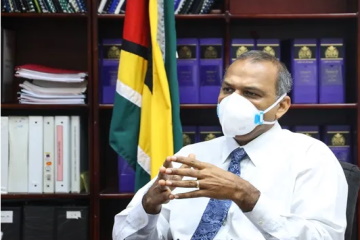
“This is something that we want to investigate and to make sure that we understand what has caused the death, …we have a team that is going to go to Moruca, they are going to do two things, one is that they are going to do a post- mortem on the body to understand the cause of death and from that we will get a better understanding of what is the cause,” said Health Minister Dr. Frank Anthony, who also expressed his condolences to the relatives of the child.
“It’s unfortunate that this young boy died and we are going to investigate and get to the bottom of it to understand what really took place and I guess after the post- mortem we will have a better idea.”
The Health Minister reiterated that the vaccines used to combat the coronavirus (COVID-19) pandemic are safe since they have undergone rigorous testing.
He noted that there are two group of reactions that could occur, the first reaction comprises mild, temporary side effects such as fever, pain, headache or fatigue that usually subside after 24-36 hours, while the second is anaphylactic shock which occurs in rare instances.
“In very, very rare cases some people might experience what is called anaphylactic shock and that’s like one person in maybe more than a million that can experience anaphylactic shock. We try to rule that out to make sure that no person who we think might have the factors that can give then an anaphylactic shock that we will give them a vaccine,” Dr. Anthony said.
He said that there is a comprehensive checklist used to ensure that this does not happen they would check to see if the person has allergies or if he/she had reactions to previous vaccines. Once the person “passes” this screening process, then he/she become eligible for the vaccine. This screening process is being used efficiently and effectively.
“The other safety reactions we have, we know that most anaphylactic reactions occur within 15 to 20 minutes after getting the vaccine and that is why the standard protocol has been to observe people for 15 to 20 minutes.”
“If anything happens within those 15 minutes, the health staff is trained to react to such situations and can recognise and treat anaphylactic shock.
So far,an estimated 363, 000 people have taken the first dose of a COVID-19 vaccine which amounts to 70.7 per cent of the total adult population. More than 212,000 people have taken their second dose which accounts for 41.4 per cent of the total adult population.
For Adolescents, 24,000 (34.5 per cent) have taken the first dose of the Pfizer vaccine while more than 13,000 (18.3 per cent) have taken their second dose.
The government said that another 100,000 doses of the Pfizer vaccine will arrive in Guyana later this week and the beneficiaries have been extended to include pregnant and breast-feeding mothers.
Dr. Anthony said the United States Food and Drug Administration (FDA) is expected to approve the Pfizer vaccine for children from five to 11 years and when that happens, children within that age group will benefit from the vaccine.
Meanwhile, in the past 24 hours, 118 persons have tested positive for the virus with 3,847 active cases.
“Both for Region 10 and Region Two, it’s a little bit worrying, because in Region 10 we have the lowest vaccination rates both for first and second doses and in Region Two they are the third lowest vaccination rates that we have seen,” Dr. Anthony explained.
He said people who are unvaccinated have a higher likelihood of infection and are more likely to contract the severe form of the disease which can lead to hospitalisation.
Currently, there are 136 persons hospitalised with 97 of those at the Infectious Diseases Hospital and 34 in the Intensive Care Unit. They are also 14 hospitalised maternal cases.
CMC/gt/ir/2021