
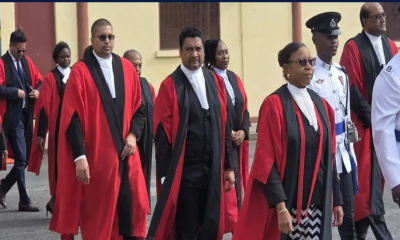
GEORGETOWN, Guyana, Jan 13, CMC – The 2026 Law Term opened here on Tuesday with the acting Chancellor of the Judiciary, Justice Roxane George-Wiltshire, calling on the Guyana government to allow the judiciary to determine its own budgetary allocation from the Consolidated Fund in keeping with the country’s constitution.
“Most importantly, I reiterate, the judiciary looks forward to full compliance with Article 122(a) of the Constitution of Guyana and the return of the judiciary of Guyana to being a fully self-accounting entity which manages its tender processes with full accountability to Parliament regarding how its budgetary allocation is spent.”
Justice George-Wiltshire told the opening ceremony that was also attended by Attorney General and Minister of Legal Affairs, Anil Nandlall, that as far as she was aware Guyana was the first Caribbean Community (CARICOM) member state that provided “such autonomy” to the judiciary.
“Therefore, full implementation of the fiscal management provision is necessary to fulfill the constitutional mandate and retain our leadership in this regard,” she added.
Article 122 (a) of Guyana’s Constitution states that subject to the provisions of articles 199 and 201, all courts shall be administratively autonomous and shall be funded by a direct charge upon the Consolidated Fund; and such courts shall operate in accordance with the principles of sound financial and administrative management.
That provision also states that all courts and all persons presiding over the courts shall exercise their functions independently of the control and direction of any other person or authority; and shall be free and independent from political, executive and any other form of direction and control.
Justice George-Wiltshire told the ceremonial sitting of the Court that the judiciary is now moving beyond a focus on physical infrastructure to a deeper transformation centred on performance, data and public trust.
She outlined the Judiciary’s Strategic Plan 2024–2031, which is anchored in service excellence through investments in human resources, management systems and technology. The acting Chancellor said that as part of that process, Guyana’s courts recently completed a self-assessment under the International Framework for Court Excellence, placing the system in the third out of five bands.
She said while that ranking reflects alignment with principles of good governance, it also exposes inconsistencies in operations and service delivery that must now be addressed system-wide.
“The next phase of transformation requires performance to be measured, improvement to be continuous, and public trust to be deepened,” she said, noting that a central pillar of that transformation is digitalisation.
The acting Chancellor said that the magistrates’ courts, which handle about 90 per cent of criminal matters, recorded approximately 30,000 criminal cases in 2025, while at the appellate level, there is a backlog of roughly 2,000 cases at the Court of Appeal, largely caused by years of insufficient judges.
Acting Chief Justice Navindra Singh described delay as one of the most corrosive threats to public confidence in the rule of law.
“Justice delayed is justice denied,” he said, stressing that active case management will define the 2026 law year.
Meanwhile, Nandlall has raised serious concerns about the failure of magistrates’ courts to apply modern legislation passed by Parliament, warning that key legal reforms are being ignored at the summary court level.
Nandlall said that while the Executive and Legislature have enacted significant legal reforms aimed at improving efficiency and access to justice, those laws are not being utilised in practice.
“We are churning out at the level of the Executive and the Parliament a tremendous amount of new, modern and innovative legislation. But I say this with the greatest of respect, I don’t think that we are reading them,” he said, making specific reference to the Plea Bargaining Act, which he said is not being applied despite its mandatory provisions.
“The first section of the plea bargaining legislation mandates a magistrate to put plea bargaining as an option to the defendant,” he said. “Mandates. The legislation is being ignored.”
In addition to plea bargaining, the Attorney General said other major reforms are also being overlooked in magistrates’ courts.
“We have the plea bargaining legislation, we have the paper committal legislation, we have restorative justice legislation, and I don’t think that they are being used in the Magistrate’s Court,” Nandlall said, adding that the problem does not lie in the absence of legislation, but in the failure to engage with and apply the laws that already exist.
President of the Guyana Bar Association, Kamal Ramkarran, told the sitting that no lawyer in Guyana has been suspended or removed from practice in more than 25 years, calling for stronger accountability mechanisms within the legal profession to address persistent delays in the justice system.
“We cannot complain that cases take too long to be completed if it is the lawyers who are delaying them by not being prepared and by seeking adjournments,” he said, pointing to what he described as a broken disciplinary framework within the Bar.
“The procedure for disciplining lawyers is cumbersome. No lawyer has ever been the subject of proceedings, suspension or removal from the court rules in well over 25 years and perhaps much longer.”
Ramkarran also raised concern over the absence of any system of continuing legal education, noting that lawyers are allowed to practise indefinitely without keeping up to date with developments in the law.
“There is no system of continuing legal education in the Bar among lawyers. If a lawyer never wanted to read another law book or judgment after law school it would be completely open for that lawyer to do so.”
CMC/gt/ir/2026