
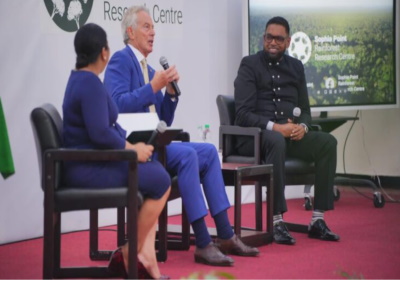
GEORGETOWN, Guyana, Aug 30, CMC – Former British prime minister, Tony Blair, says he hopes the upcoming United Nations Conference of the Parties (COP 28) will result in developed countries injecting large amounts of financing to shift from fossil fuels to cleaner energy by poorer nations.
“I hope that this COP comes up with a significant and improved framework whereby the developed world realises its job is to help that process of financing the energy transition in the developing world,” Blair told a panel discussion following the launch of the University of Guyana’s Sophia Rainforest Research Centre on Tuesday.
The Executive Chairman of the Tony Blair Institute for Global Change said that would be the biggest issue at COP 28 that will be held in the United Arab Emirates (UAE) from November 30 to December 12 this year.
Blair had acknowledged that originally, western countries such as the United States as well as Europe had “created” the climate crisis, but as developing nations such as India, China and other Southeast Asian nations grow by 2030, the combined emissions of the US and Europe would be 20 per cent while those from China and Southeast Asia would be almost 70 per cent.
The former British prime minister also said there was a crucial role for India and China in combatting climate change, and urged nations to find a middle ground in addressing the climate crisis that has been wreaking havoc through intense droughts, severe floods and violent storms.
”Whatever problems we have that are in the realm of confrontation, we can’t solve climate change without developing technology and we can’t develop the technology unless countries like China and India are part of the solution,” he said
Blair also called for an end to the more 20-year standoff between environmentalists and developmentalists, and urged that they instead strive for a combined balance between the two.
“It won’t happen, in my view, unless we understand that at a certain point that we really consider the interest of humanity. Whatever disagreements we have, whatever factors and breaks that we have in the international community over various issues- of course they’re important- on this issue of the environment, the world has got to stand together or they fall together,” he told academics and policymakers.
Blair said that Guyana, as a developing country, has a task of earning revenues from oil and gas while protecting the environment.
“This is why Guyana is such an interesting country because you are going to have to develop. You will have the capacity to develop with the oil and gas industry but at the same time you want to be responsible stewards of the environment so you, in a way here, personify the dilemma that the world has,” he said.
Guyana, despite being an emerging major oil producer in Latin America and the Caribbean, has developed a low carbon development strategy. American oil company, Hess, last year purchased $750 million worth of carbon credits between 2022 and 2032.
President Irfaan Ali, who also participated in the panel discussion, said Guyana remains a staunch advocate for a better price for carbon credits on the world market, as he dealt with the issue of balancing development with protection of rainforests.
He told the audience that the Community of Latin American and Caribbean States (CELAC) has a financing gap of US$2.3 trillion of investment to achieve essential sustainable development goals by 2030.
“No one knows where that money is coming from. That is the development challenge,” he said, supporting the International Monetary Fund’s (IMF) recommendation that the carbon credit price be increased from less than seven US dollars per tonne to US$70.
He said Guyana also faces further complications when the underwhelming prices for carbon credits on the world market is considered.
“We are blessed with a lot of natural resources. But if you have a country with a standing forest and there’s no market for the standing forest. The people of that country still have to eat. The people of that country still have to (focus on) development,.
“So, what is very critical, as all the studies would have shown, for us to achieve the transition we want with energy, and for us to achieve the shift in development focus, the carbon price must be US$70 per tonne. It is not even seven US dollars. And that is why the market is so important. We have to fix that fundamentally,” Ali said.
Ali said the region as a whole must collaborate in order to fix this fundamental pricing issue. Until this is done, he noted, the question of achieving a balance in developing and protecting the resources will remain prominent.
“Unless we’re able to fix the fundamentals, this question and this balance would continue to confront us. How is it we can get the world to agree that the price for carbon credits, based on what we want to achieve, net zero, must be US$70? Are we willing to make that bold and important decision?”
Meanwhile, the the Sophia Point Rainforest Research Centre said it aims to serve as a hub of research, education and training for stakeholders seeking to fight against climate change.
The centre is co-founded by United Kingdom parliamentarian David Lammy and his wife, Nicola Green.
During the inauguration ceremony, Lamm, who has guyanese heritage explained how this solar-powered, environmentally conscious centre, situated at the confluence of the Essequibo, Mazaruni and Cuyuni Rivers, will work to protect and better understand Guyana’s rainforests.
“The centre will make the environment more accessible, providing a platform for students, academics and researchers to study this overlooked and undervalued country–a location metropolis potential for terrestrial, freshwater and marine research but also a site to facilitate education beyond the biological sciences, to engage with local and indigenous communities, music and arts and to tie into the existing vibrant and committed community of conservationists in Guyana, amplifying efforts already underway,” Lammy said.
He said that Sophia Point will add to the forest research and conservation efforts already being done through the Iwokrama Research Centre and further facilitated by other key organisations.
“As the government has rightly recognised in their Low Carbon Development Strategy (LCDS) 2030, capacity must be built to deliver a sustainable future for Guyana’s rainforest and Sophia Point hopes to achieve that through collaboration, not competition,” Lammy said.
He said this can be done by working with the likes of the Protective Areas Commission, the Guyana Marine Conservation Society, the South Rupununi Conservation Society, World Wildlife Fund (WWF) and the surrounding Amerindian communities.
“If you look around the globe, at comparable countries, you can see what the standard is. Costa Rica, a country four times smaller than Guyana, has 44 research centres. Panama, a country three times smaller than Guyana, has 12 interconnected sites just run by the Smithsonian Tropical Research Institute alone,” Lammy said.
CMC/gt/ir/2023