
GEORGETOWN, Guyana, Jul 23, CMC – Several heads of state and government have joined several other stakeholders indigenous communities in expressing their collective commitment towards strengthening global action for the protection, restoration, and sustainable use of the planet’s biodiversity.
The signatories said that the Declaration marks the launch of “a shared and evolving framework that is open, voluntary, and inclusive.
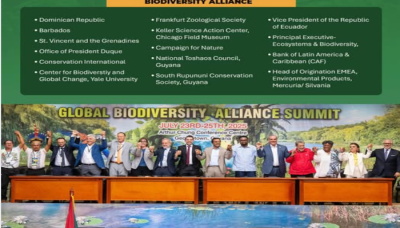 “ It is intended to unite, elevate, and amplify the efforts and impact of all those working for a healthier, more just, and more resilient planet,” they added.
According to the Georgetown Declaration issued here on the opening day of the inaugural Global Biodiversity Alliance Summit, the signatories, which includes the host head of State, Irfaan Ali, the President of the Dominican Republic, Luis Abinader, the Vice President of Ecuador, María José Pinto and the Prime Minister of Barbados, Mia Mottley and her St. Vincent and the Grenadines counterpart, Dr. Ralph Gonsalves, said biodiversity is fundamental to human well-being, climate stability and resilience, food and water security, public health, and the long-term sustainability of ecosystems.
The Declaration, which was also signed by the former president of Colombia, Iván Duque Márquez, as well as Mauricio Velasquez, Principal Executive- Ecosystems & Biodiversity, Bank of Latin America & Caribbean (CAF), notes that through the United Nations Convention on Biological Diversity, 196 Parties have committed, through the Kunming-Montreal Global Biodiversity Framework, to halt and reverse biodiversity loss, placing nature on a path to recovery by 2030, and achieving a world living in harmony with nature by 2050.
The signatories have also reaffirmed their commitment to advancing efforts in support of the Kunming-Montreal Global Biodiversity Framework, adding “we encourage and support the promotion of sustainable and inclusive bioeconomy pathways that contribute to conservation and restoration, particularly in regions of high ecological value such as the Amazon Basin”.
They said driven by the urgency of the need to address these issues, “we collectively establish the Global Biodiversity Alliance (GBA) as an open, adaptive, and non-binding platform for voluntary actions by diverse actors to address the root causes of biodiversity loss through policies and actions”.
The Declaration states that the Global Biodiversity Alliance aims to raise global awareness of the biodiversity crisis and its interlinkages with other global challenges, such as climate change as well as increase ambition at every scale to address global biodiversity loss.
The Alliance is also intends to increase access to and availability of financing, through a menu of options, to address the biodiversity crisis as well as serve as a collaborative space that complements and strengthens existing efforts, particularly those under the United Nations Convention on Biological Diversity.
The Declaration is urging countries to provide the political leadership and institutional legitimacy necessary to drive change at the national and international levels, ensuring that biodiversity becomes a central priority in development strategies and public policies.
“It is envisioned that the GBA would enhance the achievement of the Kunming-Montreal Global Biodiversity Framework targets, thereby contributing towards greater progress at the global level,” the Declaration states , noting also that multilateral organizations possess the convening power, technical expertise, and operational reach, “to play a vital role in aligning global efforts and mobilizing international cooperation and financing.
“The private sector brings essential resources, innovation, and the capacity to scale solutions, and is crucial to transform production and consumption to realise sustainable value chains that protect and enhance biodiversity.”
It said academia and the scientific community provide rigorous evidence-based information, cutting-edge research, and monitoring tools that inform decisions and strengthen the effectiveness and impact of biodiversity conservation actions, outlining also a role for civil society and indigenous groups.
“We recognize that the effective implementation of these commitments requires adequate, predictable, and accessible financing. We therefore commit to enhancing resource mobilization from all sources and aligning financial flows with biodiversity objectives, in accordance with the provisions and principles of the Convention on Biological Diversity.
“We call for strengthened international cooperation and the development of innovative financial mechanisms to support developing countries in achieving their biodiversity goals.”
The Declaration said that a menu of innovative financial options and instruments could be explored and encouraged, including biodiversity credits, green bonds, debt-for-nature swaps, payment for ecosystem services schemes, sustainable taxonomies that align sustainable investment with measurable outcomes in conservation, restoration, and ecosystem-based climate action, and facilities like the Tropical Forest Forever Facility (TFFF).
The signatories said that they welcome the plans to launch the Tropical Forest Forever Facility at COP30 in Brazil in November this year, recognising it “as an innovative mechanism designed to mobilize long-term, results-based financing for tropical forest conservation.
“This Declaration is non-binding and reflects a shared will to build a common working agenda that shall be shaped jointly and inclusively. It is open to all actors who share its purpose of safeguarding biodiversity as a global strategic asset, and is free from impositions and rigid frameworks.”
CMC/gt/ir/2025