
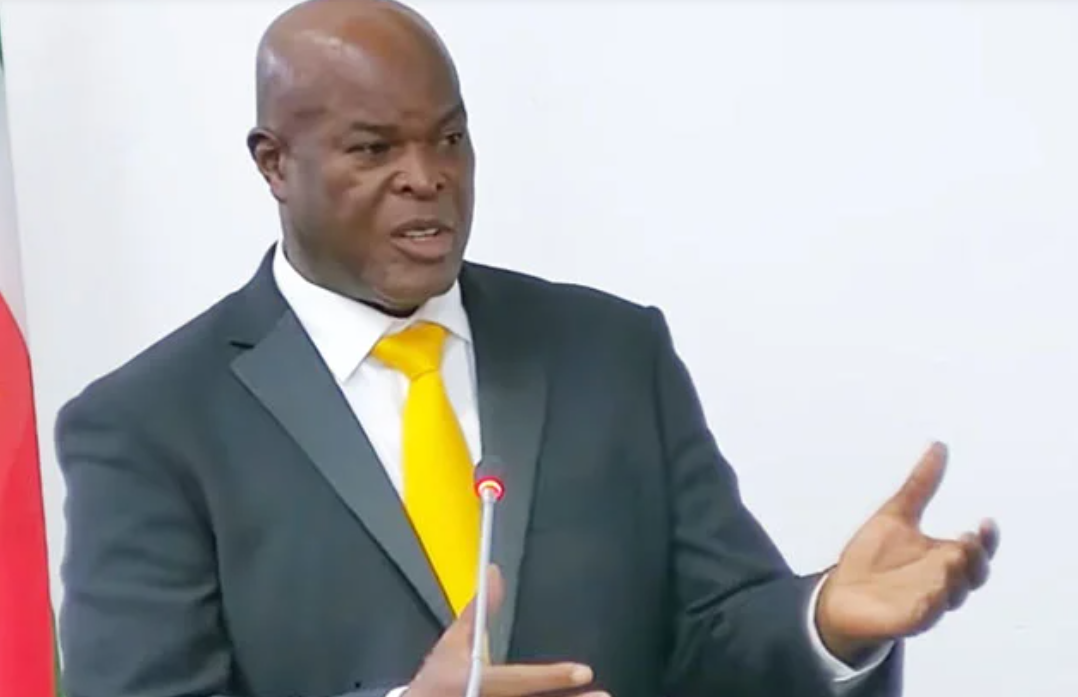
PARAMARIBO, Suriname, Nov 18, CMC – Former vice president Ronnie Brunswijk has raised objections to the agreement the Suriname government signed with the United States in 2024 aimed at curbing international drug trafficking.
Brunswijk, who served as vice president of the Dutch-speaking Caribbean Community (CARICOM) country from July 2020, to July 16, 2025, told the National Assembly that the treaty contains provisions that undermine Suriname’s national sovereignty and independent decision-making.
The Chairman of the Committee of Rapporteurs is calling on the Jennifer Greelings-Simons administration to renegotiate the accord before it gets approval by the National Assembly.
During his contribution to the debate, Brunswijk raised four objections noting that while Suriname needs international support to combat drug transport via the airspace, this cooperation must not come at the expense of the constitutional order and national interests. He said in examining the agreement, the balance between international cooperation and the protection of Surinamese state sovereignty has tipped seriously.
The former vice president, who founded the General Liberation and Development Party (ABOP), said that one of the most serious objections relates to Article 4 of the agreement. According to Brunswijk, it is stipulated therein that Suriname may not share information, data, and analyses obtained with American support with third parties without prior written permission from the American embassy in Paramaribo.
The former rebel leader believes that this effectively grants a foreign diplomatic representation veto power over information relating to law enforcement and Suriname’s national security.
He told legislators that he considers this an unacceptable restriction on national decision-making authority, as contained in Article 2 of the Suriname Constitution.
He said that a second objection concerns the operational implementation of the treaty and that although the Surinamese Air Force formally remains responsible for intercepting suspicious aircraft, Brunswijk argues that it will become significantly dependent on American radar data, intelligence, and technical support.
He said he fears that this will create a situation in which the United States effectively determines which information is passed on and which operational standards are applied.
Brunswijk acknowledges that Suriname does not possess sufficiently advanced means to monitor its airspace independently.
Brunswijk said that while that is precisely why American support is important, dependence should not mean that Suriname loses control over its own security policy.
He said another objection to the agreement is that section 5 gives the United States the right to immediately suspend or terminate support if Washington determines that Suriname is not complying with the conditions.
The former vice president said he believes that such an arrangement creates an unequal relationship between the two countries and that in his view, Suriname should also have the option to terminate the agreement if the other party fails to adhere to the terms.
Brunswijk said that a major problem is that the agreement was already entered into by the then-government in 2024 through an exchange of diplomatic notes.
According to him, the Surinamese reply note of October 15, 2024, was sent without reservation and as a result, the National Assembly cannot independently amend the provisions.
According to Article 103 of the Constitution, Parliament can only decide whether or not to approve the agreement and Brunswijk reiterates that the government must therefore re-enter into consultations with the United States to address the objections.
He proposes agreeing on a supplementary protocol or amendment in which the restrictions on information sharing are removed and national sovereignty is better safeguarded.
Brunswijk said that his objections should not be viewed as him being opposed to cooperation with the United States, noting that on the contrary, Suriname desperately needs the technological and logistical support.
He said that Suriname not fully equipped to independently detect and intercept illegal drug flights and that the US radar systems and other technical means can make a significant contribution to combating cross-border crime.
CMC/hg/ir/2026