
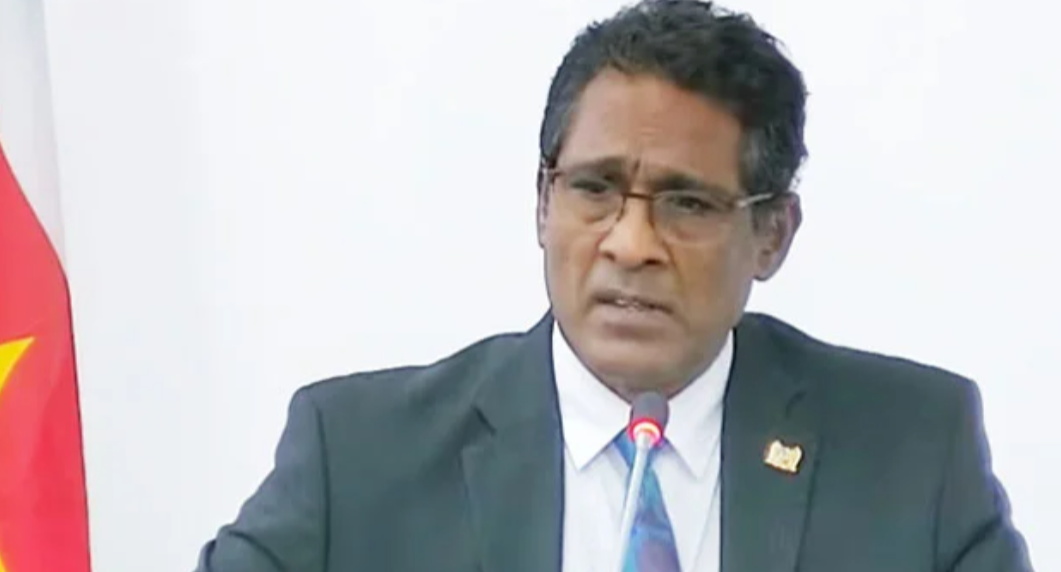
PARAMARIBO, Suriname, Nov 18, CMC -An opposition legislator is calling on the Surinamese government to accept support from the United States in combating international drug crime despite the legal and political objections to the agreement.
Progressive Reform Party (VHP) member, Dew Sharman, told the National Assembly debate on the treaty that the situation in the interior of Suriname is so serious that waiting any longer would further jeopardise national security.
Sharman, who is a member of the committee of rapporteurs, said that while he acknowledges that the agreement contains provisions that raise questions regarding Suriname’s national sovereignty and independent decision-making, nevertheless, he believes that Parliament should give greater weight to the practical necessity of international support.
“Don’t keep harping on legal imperfections. We can always get those adjusted in a mature bilateral relationship. Instead, seize the aid and support with both hands to tackle transnational crime in a targeted manner,” he told legislators.
Sharman said that there is a serious encroachment on Surinamese airspace by illegal aircraft, referring to information he said he had received indicating that on an average, four to five drug drops take place per day, possibly even more.
He said that the situation is exacerbated by the fact that foreign criminal organizations are active in the hinterland, while the Surinamese authorities lack sufficient resources to act effectively against them.
Sharman told the National Assembly that the relevant authorities are barely able to assert their authority in parts of the interior and as a result national security is coming under pressure.
“We don’t have the people, we don’t have the resources. We have nothing. We don’t have equipment,” Sharman said as he responded to questions from other Assembly members.
Sharman warned that the situation could escalate further if the approach to drug crime is delayed for years again.
The agreement was concluded in October 2024, but is only now awaiting parliamentary approval. According to him, it would be unwise to wait another two, three, or four years until all legal objections have been resolved.
Sharman said the agreement provides, among other things, for American support in locating, identifying, tracking, and intercepting suspicious civilian aircraft. In doing so, Suriname can make use of radar and intelligence data, equipment, training, and logistical support. Although operational responsibility formally remains with Suriname, Sharman sees risks in the practical implementation.
He questioned what would result if Suriname lacked sufficiently trained personnel and technical resources and became heavily dependent on American intelligence.
He also found problematic, the provision that certain information obtained with American support may not be shared with third parties without prior permission from the American embassy. Sharman said this could create a situation in which the United States effectively gains influence over Surinamese security information and decision-making.
The opposition legislator also noted that Washington could unilaterally suspend or terminate the support, saying this could place Suriname in a dependent position.
“We are being maneuvered a little bit into a sort of underdog position,” he said, reiterating that the agreement was accepted in 2024 without reservation or counter-proposal.
He said as a result, the National Assembly cannot independently amend the text and that adjustments would require new agreements with the United States.
But he urged the government to investigate whether the main objections could still be addressed in this way, while also seeking clarification on whether the agreement allows for the establishment of an American military base in Suriname for the coordination of operations. Furthermore, he asked who ultimately decides on the use of force during an interception and who is liable if damage or casualties occur.
According to him, liability for wrongful conduct is not clearly regulated in the agreement.
Sharman said while he does not wish to make any concessions regarding national sovereignty, sovereignty is also compromised when foreign criminal organizations make virtually unhindered use of Surinamese territory and airspace.
He said Parliament should therefore not only look at the potential risks of American support, but also at the consequences of the failure to take effective action against cross-border crime.
“Don’t think dogmatically, but act pragmatically. That is where the country’s advantage lies,” Sharman said.
CMC/lk/ir/2026