
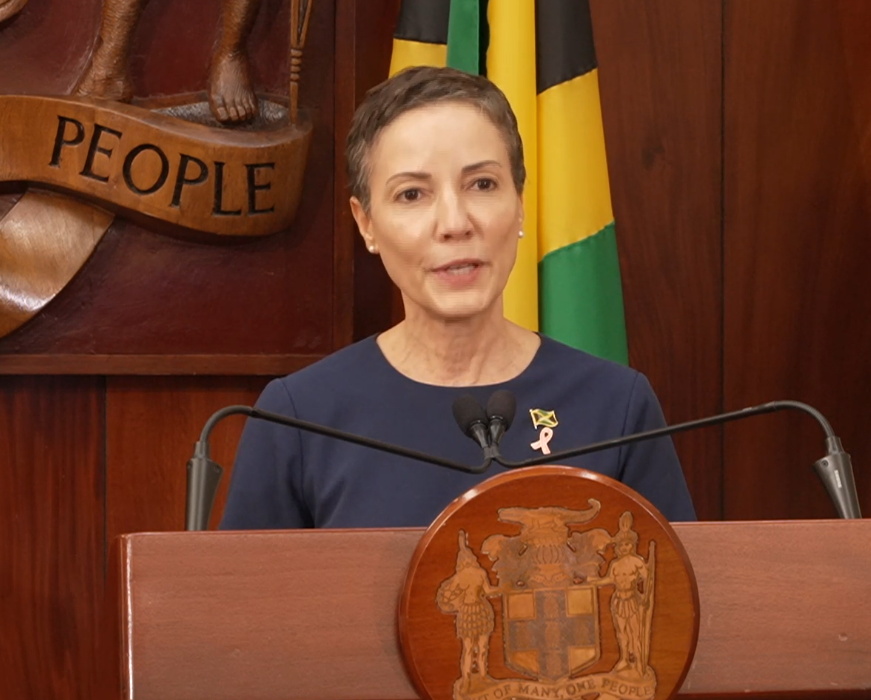
KINGSTON, Jamaica, Nov. 1, CMC – The Jamaican Government says its decision to abstain from a United Nations vote calling for an end to the United States embargo against Cuba does not signal a shift in its longstanding opposition to the economic restrictions.
Foreign Affairs Minister Senator Kamina Johnson Smith made the assertion on Sunday, dismissing criticism from former Prime Minister PJ Patterson, who described the Government’s decision as an “abominable betrayal”.
Patterson, in a statement on Saturday, condemned the abstention as a departure from Jamaica’s traditional support for the annual UN resolution demanding an end to the US economic, commercial and financial embargo against Cuba.
“It was a day of shame for the land of Marcus Garvey, and a stain on the record of a nation which, before we had even raised our own flag, closed its ports to trade with apartheid South Africa,” Patterson said.
However, Johnson Smith, while acknowledging Patterson’s contribution to Jamaica’s foreign policy, said his criticism was disappointing and relied “heavily on emotions, mischaracterisations and conclusions that do not withstand scrutiny”.
She maintained that Jamaica remains opposed to the embargo, citing its impact on the Cuban people and reaffirming the country’s longstanding friendship and cooperation with Havana.
The Foreign Affairs Minister said the Government had instead reassessed whether continued support for a resolution focusing on only one aspect of Cuba’s challenges represented the most constructive diplomatic approach.
“Mr Patterson’s suggestion that an abstention amounts to support for the embargo, or silence in the face of Cuban suffering, is simply incorrect,” she said.
Johnson Smith stressed that abstaining from a vote was fundamentally different from voting against a resolution, noting that Jamaica had formally explained its position immediately after the vote.
She said Jamaica’s ambassador to the UN acknowledged the impact of external economic restrictions on Cuba while also highlighting domestic economic and structural challenges facing the country.
According to Johnson Smith, Jamaica called for reduced restrictions, constructive engagement and Cuba’s greater integration into the international economic system.
“It is true that Jamaica could have voted in favour while expressing reservations. But an explanation of vote does not alter the position conveyed by the vote itself. Our decision reflected an assessment of the resolution in its entirety,” she said.
The minister also rejected suggestions that the Government had remained silent on the issue, noting that she publicly addressed the decision at a post-Cabinet press briefing in Kingston shortly after the vote.
“In what world can this be honestly described as silence?” she questioned.
CMC/jm/kb/2026