
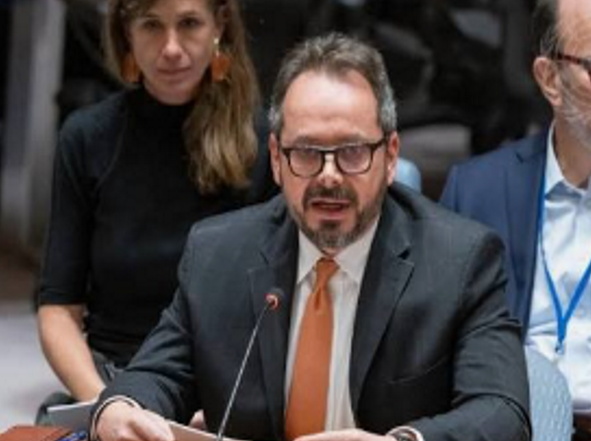
UNITED NATIONS, Oct 19, CMC – The United Nations Security Council was told on Monday that armed groups in Haiti are adapting to intensified security operations, stepping up reprisals against civilians and extending their reach into rural areas.
Monday’s briefing came two weeks after presidential and legislative elections planned for December 13 were postponed indefinitely, with the UN’s top official in the country cautioning against setting new dates without a realistic assessment of whether a vote can be held.
Haiti has not held national elections since 2016 and Carlos Ruiz Massieu, the UN’s top official in Haiti, said nevertheless, preparations are ongoing.
He said more than 35 political parties and groups, and 3,500 candidates have registered and as of October 5, however, only 759,257 potential voters were on the lists, out of an estimated electorate of 6.5 million people.
Insecurity and mass displacement are further complicating the organization of the election.
“Setting new dates for elections without a realistic assessment of their feasibility will only erode public confidence and the credibility of Haitian institutions,” he warned.
“I strongly condemn these acts and urge Haitian authorities to take all necessary measures to protect local populations, including by strengthening the capacity of national security institutions to respond effectively to evolving threats.
He said he also welcomes the decision of the government of Haiti “to substantially increase funding to national security institutions and strengthen the capacities of the Haitian National Police and the Armed Forces of Haiti.
“These efforts, with the support of international partners, are essential to enabling Haitian institutions to assume greater responsibility for restoring stability and extending State authority,” he added.
The UN Security Council was told that 1,123 Haitians were killed and 440 injured in gang-related violence between July and early October and sexual violence remains widespread, with 689 women and girls reportedly raped by gang members in July and August.
The Security Council was also informed that the authorised Gang Suppression Force (GSF) is not yet fully deployed and that the security forces are intensifying their operations, but that the gangs are not giving up.
They are adapting their tactics, increasing reprisals against civilians and spreading violence to rural areas, according to the Secretary-General’s latest report.
“What is particularly worrying is the gangs’ ability to adapt their tactics as security operations intensify,” said Massieu.
“Experience has shown that security operations alone cannot deliver lasting stabilization. Sustainable progress requires a comprehensive Haitian-led approach that combines territorial recovery with a sustained State presence, and coordinated efforts in disarmament, dismantlement and reintegration, with particular attention to children recruited by gangs.”
He said the Haitian people continue to demonstrate remarkable resilience in the face of extraordinary hardship and that they now deserve to see tangible improvements in their daily lives.
“I therefore call on Member States to sustain their support for Haiti and their solidarity with the country. This includes contributing to the Trust Fund for the Gang Suppression Force and the Haiti Peace Dividend Fund, advancing a complementary approach that combines security interventions with efforts in justice, disarmament, dismantlement and reintegration.’
Armed groups are increasingly resorting to hostage-taking, intimidation and reprisals against civilians to maintain their territory and challenge state authority.
The attack carried out on August 23 and 24 in Kenscoff, a mountainous town southeast of the capital, Port-au-Prince, illustrates this strategy the UN said, noting that at least 47 people were killed, 22 wounded, and 52 taken hostage, 13 of whom were later freed thanks to local initiatives supported by the UN.
In the West and Artibonite departments, 241 people were killed for allegedly resisting gangs.
Other attacks – notably in Saint-Michel-de-l’Atalaye, Marigot, and Léogâne – indicate a spread of violence into rural areas. Armed groups are also targeting farmland, homes and public infrastructure.
Security force operations also contribute to the rising death toll. They account for 52 per cent of Haitians killed or wounded since the beginning of July, or 808 people, including 148 not associated with gangs.
Faced with this violence, the UN Security back GSF is continuing its deployment and as of
October 12, it had 1,563 uniformed members, far fewer than the 5,550 authorised by the Security Council.
It has notably established a base in the Artibonite region, beyond the capital.
But, armed groups retain the capacity to retaliate.
On Sunday, an armoured vehicle transporting Salvadoran soldiers from the force was attacked in Croix-des-Bouquets, in the Port-au-Prince metropolitan area. Media reports said that four soldiers were still missing on Monday.
Massieu told the UN Security Council that retaking territory will not be enough.
“Experience has shown that security operations alone cannot bring about lasting stabilisation,” he warned, calling for the permanent restoration of the State’s presence and the development of disarmament and reintegration programmes, particularly for children recruited by gangs.
“This persistent insecurity also jeopardises the return to democracy, he said.
Adding to this political uncertainty is a humanitarian crisis.
Nearly 1.5 million people have fled their homes, including more than 740,000 children.
The economy is expected to contract for the seventh consecutive year, while the UN’s 2026 humanitarian plan is only about half funded.
The country thus remains faced with a dual emergency: restoring security essential for holding elections, without which a return to democratic institutions remains out of reach.
Meanwhile, Stéphane Dujarric, the spokesman for the UN Secretary-General, Antonio Guterres, said on Monday that according to the United Nations Children’s Fund (UNICEF), over 1,600 schools are closed and 95 are being used to shelter displaced families.
He said keeping children in school is critical to protecting them from recruitment by armed groups and that UNICEF reports that the number of children in Haiti recruited and used by armed groups surged by an estimated 200 per cent last year alone.
“In September, we and our humanitarian partners helped nearly 3,000 children access alternative learning opportunities, including catch-up classes and non-formal education.
We also distributed school backpacks and notebooks and pens to more than 4,600 children, provided psychosocial support to 2,000, and helped over 175 displaced children return to the national education system,” Dujarric told the daily UN press birefing.
“However, as you can imagine, the funding is not keeping pace with the growing needs. The education response under the Humanitarian Response Plan has only gotten 30 per cent of the US$61.7 million that we need, and we need more money,” he added.
CMC/kj/ir/2026.
CMC/ag/ir/2026