
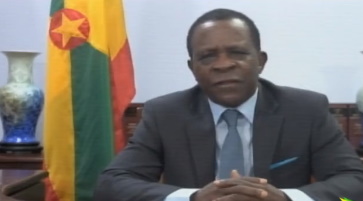
ROSEAU, Dominica, Oct 4, CMC – Grenada’s Prime Minister Dr. Keith Mitchell, Monday called for access to concessionary financing to help regional countries rebuild following environmental shocks and urged the international community to re-think its policies regarding aid to same island developing states (SIDS) like those in the Caribbean.
Addressing the regional conference on Human Mobility & Climate Change Data in the Eastern Caribbean,’ Mitchell, who is also the chairman of the sub-regional Organisation of Eastern Caribbean States (OECS), said the experiences of OECS countries and the available data on climate change effects have illustrated the vulnerability of small islands to environmental hazards, and the significant impacts of these events.
“Moreover, these events are happening with increased frequency and are more impactful and detrimental,” Mitchell said, noting that OECS nationals can easily relate to the devastation brought about by at least one major environmental disaster in recent times.
“For all our countries, the experiences of environmental hazards are the same. Significant loss in gross domestic product (GDP), decimation of our agricultural and tourism sectors, loss of precious lives, significant displacement of people and decades of economic development gains lost in just one major disaster.
“Therefore, we are cognizant of the insurmountable threats that environmental hazards can pose to economies of our countries and the well-being of our people, hence the need for urgent and swift actions to address and mitigate these threats.”
Mitchell said that the international community is becoming increasingly appreciative of the reality of SIDS like those of in the region, in particular as “we continue to advocate for the incorporation of a multi-dimensional vulnerability index as opposed to the strict reliance on traditional global economic indicators such as GDP per capita income.
“This is in recognition of our extreme vulnerability to economic and environmental shocks. Access to concessionary financing to help our countries build back better following environmental shocks such as major hurricanes, will depend on international financial institutions giving consideration to the extreme vulnerability of SIDS, to these shocks,” Mitchell said.
The Grenadian leader said that the region is pleased that amidst the global coronavirus (COVID-19) pandemic, the Alliance of Small Island States (ASIOS) and the United Nations have strongly advocated for the development of a composite vulnerability index for SIDS.
“We have received various forms of support from the international community to enhance national and regional capacity to address human mobility and climate change adaptation. This support has helped to address the resource constraints facing our countries amidst economic contractions due to the COVID-19 pandemic alongside increasing climate change threats.”
The conference here is being hosted by the International Organization for Migration (IOM) – the UN Migration Agency with the support of the German Federal Foreign Office, in collaboration with the St. Lucia-based OECS Commission.
The organisers said that the conference will allow for the discussions on the findings of a regional study (2020-2021) to assess national and regional data systems on migration, environment, disasters, and climate change in the six independent member states of the OECS.
The findings of the study will be presented, along with recommendations, in a new set of reports on “Migration, Environment, Disasters and Climate Change Data in the Eastern Caribbean” which will be launched at the event.
Ultimately, the conference aims to arrive at a roadmap to enhance the capacities of the governments of the six participating OECS member states to collect, analyse and utilise data on migration, environment, disasters and climate change, for evidence-based policymaking.
In his address, Mitchell said that as OECS chairman, he wanted to assure delegates that “this conference represents an important intervention for member states.
“Understanding the impact of these environmental hazards and the associated movement of people, through enhanced data collection and analysis and improving the governance framework for addressing human mobility and climate change adaptation, is invaluable to our national and collective responses to these hazards,” he said, adding “therefore, the outputs of this project will contribute to building resilience to these environmental threats”.
CMC/ad/ir/2021