
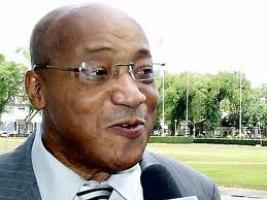
In fact, he left Bouterse’s National Democratic Party (NDP) which held ultimate power in the Dutch speaking Caribbean Community (CARICOM) country after a military coup there in the 1980s, and formed his own Democratic National Platform 2000 that catapulted him to the highest office in the land from 1996 till 2000.
But now the two leaders have buried the proverbial political hatchet and Wijdenbosch, who is now Chairman of an economic advisory council, is turning out to be a strong and fierce supporter of President Bouterse and his government that came to office in 2010.
“When this government was sworn in, Holland ceased its development aid and that was something Suriname was always fearful of. We were told that without development aid we would become totally dependent, but we have achieved the opposite,” he told a packed town hall meeting on Saturday, sponsored by the government.
“Suriname always struggled with a deficit of three per cent, even when we had the advantage of receiving development aid. Today Suriname has a finance surplus of one per cent, which means we could be able to pay off all current creditors.
“We did this on our own, without help from Holland … we have accepted the job and we’re carrying it out with the highest form of inspiration,” Wijdenbosch said to loud applause as he spoke eloquently about the policies of the Bouterse government that are being hailed by local critics and international observers alike.
While the former head of state outlined the socio-economic progress in the Dutch-speaking country over the past few years, supporters of President Bouterse handed out a newsletter outlining the government’s achievements.
“I’m here to rectify all the incorrect doom and gloom reports about Suriname’s economy that appear in Dutch media and in some media in Suriname. The opposite of those stories is true,” said Wijdenbosch,who also served as prime minister from 1987-88.
He said that while the government faced tough decisions, it made a conscious decision to focus on sustainable production.
“History gave us a thriving bauxite industry, which earns 35 per cent of our gross national product (GNP), but truthfully only provides 17 per cent of the jobs in the country,” he said, indicating that the government’s focus was on improving areas such as employment, health, education and social programmes.
“While big countries are facing economic difficulties and are forced to cut their subsidies of social provisions, we have been able to increase pensions from SRD$200 to SRD$500 (One Suriname Guilder =US$0.30 cents). Child support has also been increased and subsidy of medical expenses is in the process of being safeguarded by the end of this year,” the former president said.
“While big countries have been forced to bail out their financial institutes, we have been able to achieve savings in Suriname,” he said, predicting that the GDP will average US$4.5 billion at year end, translating to US$8,000 per capita.
He is also predicting that Suriname’s trade balance, will, for the first time show a surplus of US$200 million.
“That means that we have exported US$200 million more than we imported. This, while big countries are facing crisis,” Wijdenbosch said, adding “it’s a totally different picture than ever before”.
He said the un-employment rate has declined from 30 to 12 per cent and the national debt had also declined by one percentage point to 17.5 percent of the GDP.
Wijdenbosch told the meeting that Suriname will experience economic growth of 4.5 per cent and that the Bouterse government is encouraging investments, particularly foreign investors, while pushing for small and mid-size industries to do business there.
“The situation of the small and midsized local businesses has dwindled to the point where they’re almost non-existent. We’re creating opportunities for these businesses. We believe in sustainability, less flight of capital and improving national efficiency. We have done a lot, but a lot more still has to be done,” he said, echoing previous calls President Bouterse made to the Diaspora to get involved in their country’s growth. Wijdenbosch said “there are many opportunities” adding that the most important thing to underscore is that “this is not just a Surinamese story.
“This is what international rating bureaus Fitch, Standard and Poor’s and Moody’s are also acknowledging,” he said, alluding to recent upgrades by the US-based financial rating agencies.
“We had expected these upgrades only in 2013 and were surprised that they materialized now already. But we’re happy with them because they’re a testament of government’s prudence. And because they have direct advantages in attracting foreign investments, which lead to growth, employment opportunities and diversification,” Wijdenbosch said.
CMC/mh/pr/2012