
MEXICO CITY, Aug 15, CMC-The Economic Commission for Latin America and the Caribbean (ECLAC) and the International Labour Organization (ILO) say in order to achieve international standards in terms of child and elder care services and leave by 2035, it would be necessary to progressively increase the resources allocated to care by an average of 0.4 per cent of gross domestic product (GDP) annually until 2035.
The two United Nations organisations have made their position known in a position paper at the XVI Regional Conference on Women in Latin America and the Caribbean that analyzes how to more effectively manage the major transformation towards the care society in the region.
 The conference ends on Friday and ECLAC’s Executive Secretary, José Manuel Salazar-Xirinachs, said moving towards the care society is one of the vital transformations required to foster more productive, inclusive and sustainable development in Latin America and the Caribbean.
“Care must be recognized as a need, as a right, as productive work that has the potential to drive the economy as a whole, and as a global public good,” said Salazar-Xirinachs.
“Latin America and the Caribbean is calling for a decade of action to accelerate the achievement of substantive gender equality and the care society. This is an urgent and unequivocal call: acting now will sow the seeds of hope for future generations and ensure that care, in all its forms, is recognized as the foundation of a more just society,” he added.
The XVI Regional Conference on Women in Latin America and the Caribbean has brought together senior authorities from Mexico, Latin America and the Caribbean as well as ECLAC’s member states, along with representatives of multilateral organizations, academia, parliaments and civil society.
The document featured comments by a number of stakeholders, including Rhoda Reddock, Vice-Chair of the Committee on the Elimination of Discrimination against Women, representing the Latin American and Caribbean Group (GRULAC).
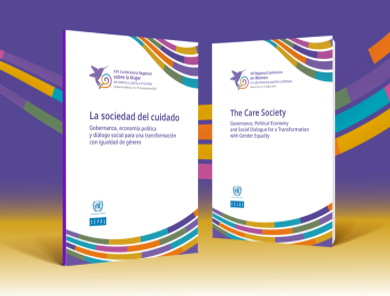
The document titled “The Care Society: Governance, Political Economy and Social Dialogue for a Transformation with Gender Equality” notes that it is necessary to develop technical, operational, political and prospective (TOPP) capabilities in the institutions responsible for this major transformation towards the care society.
It said key to achieving this goal are spaces for social dialogue to forge broad, shared visions; the governance schemes and capacities of the institutions responsible for care policies and systems at all levels as well as the cultural shift needed to challenge patriarchal patterns and make the reappraisal and redistribution of care between men and women viable.
The care society concept, the document explains, prioritizes the sustainability of life and the care of people and the planet, recognizing the synergistic interdependence among people, the environment, and economic and social development.
According to the publication, eight countries have passed laws establishing national care policies and systems, while 15 countries have established maternity leave of at least 14 weeks. It said four countries have implemented paid parental leave.
With regard to statistical advances, 24 countries have official time-use measurements; 18 report on Sustainable Development Goas (SDG) indicator 5.4.1 on unpaid domestic and care work; and 5 have calculated an official satellite account for unpaid household work.
ECLAC and ILO said that in order to achieve international standards in terms of child and elder care services and leave by 2035, it would be necessary to progressively increase the resources allocated to care by an average of 0.4 per cent of GDP per year until an annual investment of 4.7 per cent of GDP is reached in 2035 for the 23 countries of the region included in the study.
The document notes that this is a substantial investment, but with tremendous benefits. These include the creation of 31 million jobs in the 23 countries with available information, which would represent 12 per cent of the labor force projected for 2035; the closure of the gender gap in labour market participation, with women’s employment rising from 52.9 per cent in 2019 to a projected rate of 63.2 per cent in 2035.
CMC/gh/ir/2025