
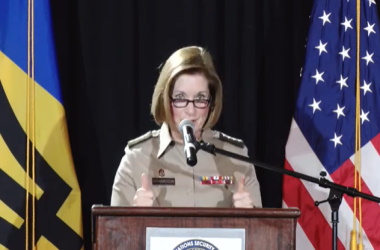
BRIDGETOWN, Barbados, Apr 6, CMC – A senior United States military official Wednesday said the recent crisis in Europe will undoubtedly impact the Caribbean and other regions in the world, such as increasing energy prices and supply chain disruptions.
But the US Southern Command (SOUTHCOM) Commander U.S. Army General, Laura Richardson, said she is also aware that the Caribbean faces unique cross-cutting threats in an ever-changing security environment.
Addressing the opening of the two-day Caribbean Nations Security Conference (CANSEC) here, Richardson said with authoritarianism on the rise, protecting human rights, and helping democracies deliver for the people of the region is more important than ever before.
“We gather here at a critical moment in world history. Last month, the world witnessed Vladimir Putin start an unprovoked and horrific invasion of the sovereign nation of Ukraine. It was the most flagrant violation of the most fundamental principles the international community established after World War Two: self-determination and national sovereignty.”
Richardson said that for decades, Caribbean countries have long been champions of these sacred principles, adding that a threat to democracy anywhere, is a threat to democracy everywhere. “CARICOM added their voice to the chorus of peace-loving democracies around the world condemning Russia’s invasion and calling for an immediate ceasefire. This region truly is a “Zone of Peace,” as all CARICOM members so eloquently stated last month. What we’re doing right here at CANSEC is working together to keep the Caribbean a Zone of Peace.”
SOUTHCOM and the Barbados Defence Force (BDF) are co-hosting the two-day CANSEC that is being held under the theme “Multinational Cooperation in a Changing Operational Environment”.
According to statement issued by the organisers, the aim of CANSEC is to promote regional and hemispheric security cooperation through expanding networks and to build enduring partnerships among military, industry and government officials.
It said emphasis will also be placed on counter terrorism initiatives, counter illicit flows operations, coordination for humanitarian assistance/disaster relief and protecting the Blue Economy with a view to countering transnational threats and enhancing regional security.
Richardson told the conference that while he recent crisis in Europe will undoubtedly impact the Caribbean and other regions in the world, the region is also facing unique cross-cutting threats in an ever-changing security environment.
“Stronger hurricanes and rising sea levels caused by climate change are destroying lives and livelihoods, tearing up family homes and reversing decades of growth,” she said, adding that what’s worse, the poverty and job loss caused by natural disasters leave many people vulnerable to crime and violence.
She said women and children especially may fall victim to human trafficking.
“In addition to the climate crisis, Caribbean countries seek more access to international finance to fund key development projects. Caribbean officials continue to work towards long-term food, water, public health, and energy security, and are coming together to tackle regional unemployment and poverty. “
But the SOUTHCOM Commander said one of the most imminent threats facing many countries are transnational criminal organizations (TCO) that are “poisoning the Caribbean and American people, trafficking in drugs, arms, humans, and other illicit products, and worsening corruption.
“Local gangs engage in violent crime, kidnapping, and sexual assault. They are even involved in illegal, unreported and unregulated fishing, robbing the region of 20 to 30 per cent of fish stocks and costing the Caribbean US$750 million dollars each year”.
She said another emerging threat that can’t be ignored, is cyber-attacks, noting that “just last year, Microsoft reported that a China-based hacking group called Nickel conducted cyber-attacks against 29 countries, four of them in the Caribbean: Barbados, the Dominican Republic, Jamaica, and Trinidad and Tobago.
She said cybercrimes have only increased in the region since the pandemic, and we must do more together to defend ourselves in the cyber domain.
“Related to this is 5G, which will roll out in the region very soon. In the Caribbean, the U.S. and other democratic societies, our citizens cherish personal privacy. But some telecommunication companies linked to the People’s Republic of China have been accused of allowing the PRC to access sensitive information about local citizens, which is a potential security risk for all of us.”
Richardson said that these cross-cutting threats are too powerful, too overwhelming for one nation to handle on its own.
“We must work together—like a cricket team or football team—all of us with the same uniforms on. That’s why CANSEC is so important. It’s a chance for all likeminded democratic partners both inside and outside the region to sync up, share best practices, lessons learned, and enhance interoperability.”
She said she was looking forward to reviewing the progress made from last year’s CANSEC, when “we focused on the impacts of the pandemic on force readiness, countering TCOs, and identifying coordination gaps within our regional response to humanitarian and natural disasters”.
CMC/pr/ir/2022
.