
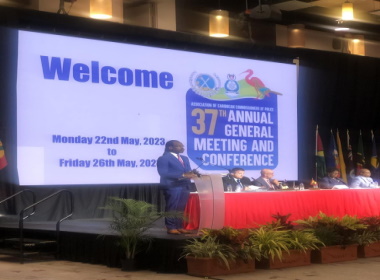
PORT OF SPAIN, Trinidad, May 22, CMC – Caribbean police commissioner began a five-day meeting here on Monday overshadowed by the increased level of crime, particular murders, in the English-speaking Caribbean Community (CARICOM) countries.
Addressing the 37th Annual General Meeting of Caribbean Commissioners of Police (ACCP), Trinidad and Tobago’s National Security Minister, Fitzgerald Hinds, said in the Caribbean Basin, the challenge of avoiding the scourge of transnational crime, the illegal drug and gun trade, the attendant laundering of funds, as well as other international criminal activities, has been amplified because the world is now a global village.
He said many countries of the region have surpassed previous records, with eight of them falling in the top 20 of the world’s most dangerous countries, based on high rates of homicides per capita.
In addition, Hinds told the conference which is being held under the theme “Transnational Organised Crime: A Growing Threat to Regional Security,” that daily in CARICOM at least 14 people are killed due to interpersonal Violence.
“The rate of violent deaths in the CARICOM member states is almost three times the global average,” he said, noting that firearms are used in more than 75 per cent of all homicides on average in CARICOM.
Hinds said in some countries, this proportion has reached 90 per cent and that last year, in Trinidad and Tobago, of the 605 murders, 87 per cent were with the use of firearms.
“Illicit small arms are fuelling armed violence, gang warfare, and organised crime, have enormous health, social and economic consequences, that thwart sustainable development efforts in CARICOM. The diversion and trafficking of firearms is a significant security threat for CARICOM and its partners; “ Hinds said, reminding the conference that Caribbean leaders had at their special summit this year declared a war on guns, particularly, assault weapons.
He said serious crimes such as armed robbery and aggravated assaults continue to increase in the region and that irregular migration continues to be a threat emanating from within and externally.
“Migration routes are shifting, and the Caribbean is now seen as a means of reaching the final destination the United States of America. The trans-shipment of cocaine is also increasing, and routes are more diverse than ever; with much more cocaine heading to Europe through very creative and varied routes.
“Cybercrimes such as online scams, ransomware and business email compromise, are increasingly problematic in the region; and the web, is now a facilitator for transnational organised crime in the region. Some of the activities include terrorism, child pornography, illicit trafficking in all its forms,” Hinds told the regional police chiefs.
He said as the more developed countries strengthen their defense against the invasion of such criminal activities, it is clear that perpetrators are diverting their attention to the Caribbean region.
“They see us as frail and having “low fences”. We have to develop muscle and height. We have to put up resistance,” Hinds said, noting that the Council of Ministers of National Security and Law Enforcement (CONSLE) agreed that the tegion should focus on firearms, human trafficking, cyber security and maritime security.
But he acknowledged that notwithstanding this focus, it is imperative that the region focuses on building domain awareness since these three domains are the main facilitators of transnational organised crime.
“In addition, it has been recognised that in order to combat transnational organised crime, there has to be a systems-wide approach, inclusive of prevention, capacity building to address intelligence and investigation, a robust legislative framework to have updated legislation to support the judicial process, a strengthened justice system, a strengthened corrections process which support rehabilitation and reintegration.”
Hinds said at the regional symposium on crime attended by the Caribbean leaders, a decision was taken to establish an entity under the CARICOM Implementation Agency for Crime and Security (IMPACS) to assist in the containment of corruption and financial crimes, including money laundering and cybercrimes.
“This would lead to greater collaboration between member states and would help in harmonising related legislation and operational processes,” he said, adding that regional cooperation is paramount and critical especially as the region strengthens its CARICOM Single Market and Economy (CSME) that allows for the free movement of goods, skills, labour and services across the Caribbean.
“As we continue the information sharing process, we must all continue to adopt a proactive approach to ensure that the scourge of crime does not stunt our region’s economic, social and democratic development,” Hinds added.
CMC/af/ir/2023