
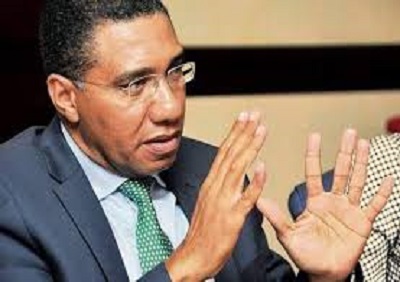
KINGSTON, Jamaica, Sept 28, CMC – Jamaica’s Prime Minister Andrew Holness Tuesday urged countries need to invest in human capital given that the labour market has changed significantly as a result of the coronavirus (COVID-19) pandemic.
Addressing the United Nations High-Level Event on Jobs and Social Protection for Poverty Elimination, Holness said as countries endure the pandemic, climate-related disasters have exacerbated current challenges and created new ones such as shifting the labour market.
The Jamaica prime minister, who is one of the co-convener of the conference, noted that the pandemic has resulted in job losses and that there is a need for new skills and training to meet the shifts to the green economy.
He said the 12 day United Nations Climate Change Conference (COP 26), which gets underway in Glasgow on October 31,will provide the platform for integrating the pillars of decent work, namely social dialogue, social protection and rights at work into the implementation of climate action policies.
Holness said that the Paris Agreement signed in December 2015 “recognises the imperatives of a just transition, which will ensure that carbon-neutral economies are adequately protected and that opportunities for the creation of decent and green jobs are fully seized.”
He said that investment in specific green sectors will have a substantial potential for creating sizable net gains in employment while simultaneously protecting the environment, adding “such a strategy must be reinforced by robust social protection systems to support workers in their transition to jobs in these new sectors.
“Given the urgent need to address these pressing and interrelated challenges, we call for action-oriented engagement among policymakers at all levels to bridge the financing gaps and to implement innovative solutions that support sustainable development and eradicate poverty.”
Holness told the conference that Jamaica has taken several steps to deal with the situation, adding “within two weeks of the first case of the COVID-19 pandemic in Jamaica, we instituted a support group for the vulnerable, poor, elderly, disabled workers and businesses to cushion the economic impact of the pandemic. This was the largest social support programme in Jamaica’s history.
“In July 2021, we implemented a new social pension programme for seniors 75 years and older who were not in receipt of a pension. These were necessary measures to mitigate the destabilising socioeconomic effects of the crisis on our population,” he said.
Holness said that as countries chart a new course towards economic recovery, countries must lay the foundation for a more resilient labour market and a more equal world.
“We must invest in up scaling and rescaling our workers for the jobs of the future to better prepare for the disruptions of the Fourth Industrial Revolution, which the pandemic has only served to accelerate.
“The pandemic has also exposed the stark inequalities and significant gaps in social protection systems. With the onslaught of the pandemic, many low and middle-income countries have struggled to mount a social protection and stimulus response of the scope and scale required to meet the need,” he added.
Holness said that highly indebted middle-income countries like Jamaica have had to apply an unprecedented number of social protection and job policy interventions to alleviate the effects of the crisis on their populations.
The Executive Secretary of the UN Economic Commission for Latin America and the Caribbean (ECLAC), Alicia Barcena pointed to the fight against tax evasion and illicit financial flows.
Barcena said these were “fundamental obstacles to the mobilization of internal resources” in her region and have a value of about US$325 billion a year.
She also mentioned the illicit financial flows resulting from the manipulation of the international trade in goods, saying they have an estimated value of about US$85 billion, or 1.6 per cent of the gross domestic product (GDP).
Latin America and the Caribbean is the most indebted region in the developing world, with the highest debt service, representing 59% of its exports of goods and services.
Barcena said debt relief is one of the measures that must be implemented, especially in the Caribbean. ECLAC proposes the relief of 12 per cent of the total debt of the regional and the creation of a Caribbean Resilience Fund.
She said the region “faces inequality, underfunded health systems and accumulated structural gaps in social protection.”
Earlier, UN Secretary General, Antonio Guterres, told the conference that almost two years into the COVID-19 crisis, a huge divergence in the recovery is undermining global trust and solidarity, according to a new policy brief on jobs and poverty eradication.
The Secretary-General warned that the pandemic has not only confirmed but deepened existing inequalities.
Investment in jobs, social protection and a just transition to a net-zero emissions future, particularly in low and middle-income countries, could prevent a further deepening of the inequalities.
“Global solidarity so far has been completely inadequate. A renewed social contract…should be central to the recovery,” Guterres said.
According to the policy brief, extreme poverty increased by between 119 and 224 million people between March and December 2020 – the first such increase in over 21 years.
More than three-quarters of these ‘new poor’ are in middle-income countries. At the same time, the wealth of billionaires increased by over US$ 3.9 trillion.
The report noted that because of the pandemic, there are an estimated 75 million fewer jobs in 2021 than there were before the crisis, and 23 million fewer projected in 2022.
It also estimates that 8.8 percent of total working hours were lost in 2020 – equivalent to the hours worked in one year by 255 million full-time workers. This corresponds to a loss of US$3.3 trillion in labour income before government support.
To achieve “a job-rich recovery” and a “just transition,” at least US$982 billion is needed to respond to the immediate labour market shocks of the crisis, the report said.
The Secretary-General called for universal social protection by 2030, including universal health care, income protection, education and skills training, particularly for women and girls.
The many ad-hoc and temporary measures that have been implemented over the past year “provide a starting point” Guterres noted.
To achieve this we must mobilize significant public and private investments – some US$1.2 trillion to achieve universal social protection coverage for low and middle-income countries, he said.
During the presentation, Guterres announced the creation of a new Global Accelerator on Jobs and Social Protection for a Just Transition, in collaboration with the International Labour Organization (ILO).
The aim of the Accelerator is to create at least 400 million jobs by 2030, primarily in the green and care economies, and extend social protection floors by 2025 to 50 percent of people currently not covered, he said.
Speaking at the event, Guy Ryder, ILO Director-General of the International Labour Organization, warned that the differences between developed and developing countries are growing, “the contrary of building back better.”
He said that “the world was not prepared for COVID-19”, but now “must be ready to deliver a recovery that benefits all.”
For him, this means injecting the necessary finance to support all countries.
“The Global Accelerator for Jobs & Social Protection is designed to channel national and international, public and private financial flows to provide social protection floors for the four billion people who fall outside any existing coverage and to the creation of decent jobs, above all in the green economy and in the care economy om the scale now urgently needed,” he said.
CMC/af/ir/2021