
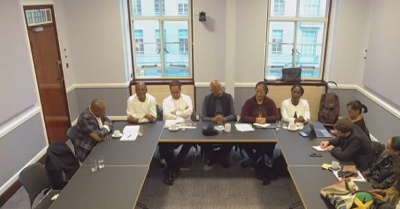
LONDON, Nov 18, CMC – The chairman of the Caribbean Community (CARICOM) Reparations Commission (CRC) Sir Hilary Beckles, Tuesday urged Britain to re-think its socio-economic policies towards the Caribbean region, criticising some segments of the British press for suggesting that the call for reparation
“Sections of the British media, rather than see the enormous hospitality of the Caribbean people, what you talk about is that we have come here to take money away from the taxpayers,” he said.
Sir Hilary, who is leading a six-member delegation on a “groundbreaking visit” to the United Kingdom to “advance its advocacy for reparatory justice”, told a news conference that there is no reason why Britain should be divided on reparatory justice for the Caribbean.
“There is no logical reason. It’s an emotional response based on the racism of a few and I believe that there is racism in the western world. I don’t believe the majority of the British people have racist tendencies,” he said, reminding the media that he grew up in Britain, attending schools here as well.
“Yes you have a few racist people knocking around the place, but the majority of the people are open minded liberal, and that is the consciousness that we want to respond to. That open liberal spirit of the British people, that what we are talking to,” he said, telling the media “you can help us to communicate that message”.
Sir Hilary recalled after the world war in Europe, the United States had provided Britain with a Marshall Plan to help it rebuild its economy with assistance also from Caribbean people who migrated to the country during the rebuilding exercise.
“Hundreds and hundreds of us came here to help with that. Clean up the place, work in the industries and put Britain back on its feet. Now, that is our joint history. You had a Marshall Plan…and it put yu back on your feet.
“Now, your smallest colonies that happen to be your oldest colonies are saying to you, why don’t you extend principles of a Marshall Plan to look at those little colonies in the Caribbean where you started”.
Sir Hilary, who is also the Vice Chancellor of the University of the West Indies (UWI), said Britain used its fiscal and monetary policies to maximise extraction from those little colonies, asking “how can you turn your back on the source of your beginning.
“It’s like parents kicking children out of the house and they are out there struggling andthey don’t even think of it. That is not a value that exists in this country. People in this country hear about those vulnerable persons who are part of their community.”
Sir Hilary said in the 1960s Caribbean leaders came here to discuss “forms of support,” noting that when Britain left the region “they left those little islands with no resources, bankrupt treasuries, no economic strategy (and) that’s what you left behind”.
He said the Caribbean countries got together and decided to seek independence with the British government indicating “if you want independence …you are on your own, not a cent from us.
“And that was our independence journey. In other words we have to clan up the mess that you have left in the Caribbean and we have to clean it up by ourselves. You don’t want to be part of that. So we said no, you have to help us clean up this mess you have created so that we can all go forward …”
Sir Hilary said that the Caribbean adopted many of the British policies, including the democracy model that had been proposed to them by London.
‘When some of the most poorest people on the plant adopt democracy that’s a major intellectual achievement,” he said, noting that the groin had also adopted the Westminster model of government.
“So we are saying to you now, it is now fair, it is not right. You need to come back to the Caribbean and participate, I did not say come back to dominate, come back to participate in the conversation about the s chools, the education…”
Sir Hilary recalled that when Jamaica gained its independence from Britain in 1962, at least 80 per cent of the people there could not read or write asking “how can you colonise an island for 300 years and after 300 years, 80 per cent of the people cannot read or write.
“Is that a legacy you are proud of. You have just left mass illiteracy behind, two hospitals for 300,000 people. We are saying no no, we have been carrying this burden of development,” Sir Hilary said, adding that Caribbean people should be congratulated as heroes for “converting your colonial mess into democracies, into stable societies…many people thought it could not be done.”
He said that there is another dimension to the region’s development, even as he criticised a segment of the British press “for not being kind to us.
“What have we done in the Caribbean? Have we not created a world to invite all of the British people, whenever you want to relax, take your children on holiday, a family vacation…did we not create an environment where we welcome you where you could walk the beaches…
“Did we not create for you the British people to come and relax …remember it was based on slavery , remember you gave us slavery and we in turn have taken your slavery and we have given you back freedom.
“We have converted your slavery into freedom and we say to you, you brought us to the Caribbean in chains…and we are saying to you now, come back to the Caribbean we will host you, no chains. You are absolutely free to walk the streets, the beaches, give your wives and husbands a little vacation…that’s the world we have created for Britain”.
He said the Caribbean wants Britain to know that it is a “stakeholder” of the region where the countries have built their economies around tourism, financial services and all of the other institutions that require an imagination.
He said Britain has benefitted from such development because “you don’t wake up in the money and hear the region has declared Britain an enemy, we see you as a strategic partner…but at the same time there is a practical issue of your legacy and all we are asking you to do…is to reflect upon this, return to the Caribbean as a partner to help us clean up the mess you have created so that going forward, all of us can enjoy the Caribbean even more so.
‘We the citizens can eradicate illiteracy in the deep poverty and we can do all of that with your support and you in turn can have a Caribbean that going forward will be your ally,” Sir Hilary said, adding “the world is changing…the British empire has fallen, the American empire, we don’t know how long it is going to last, but everyone nw needs new friends and allies to survive.
‘You are not going to survive in the coming world without friends and allies and here is your predicament, when the Americans gave you the Marshall Plan …you and the Americans got together and said, oh, there is a special bond between Britain and the United States…
“Where is your special bond with the Caribbean and do you not want us to say that the Marshall Plan that you enjoyed is what you owe to the Caribbean? The same Marshall Plan the Americans gave you, you must give us, help us to build the place …so that we too can be saying in the years ahead, there is a special bond between Britain and the Caribbean”.
A CARICOM Secretariat statement issued ahead of the visit here, said that the delegation’s mission is to strengthen strategic partnerships and promote a joint programme of public education and engagement on the reparations agenda, adding that the visit is being organised with the Institute of Commonwealth Studies, which will host the delegation’s meetings and events.
“This marks the first official visit by the CRC to the UK as a collective body. The itinerary includes high-level engagements with High Commissioners and Ambassadors from CARICOM member states and the African Union, UK Parliamentarians, including members of the All Party Parliamentary Group for Afrikan Reparations, civil society leaders, academics, media professionals, and members of the Caribbean diaspora,” the Secretariat said.
“The visit underscores the CRC’s commitment to building international alliances and fostering dialogue around reparatory justice, historical accountability, and socio-economic transformation,” it added.
The CRC is a regional body created to establish the moral, ethical and legal case for the payment of reparations by the governments of all the former colonial powers and the relevant institutions of those countries, to the nations and people of the Caribbean Community for the Crimes against Humanity of Native Genocide, the Trans-Atlantic Slave Trade and a racialized system of chattel slavery.
CMC/gt/ir/2025