
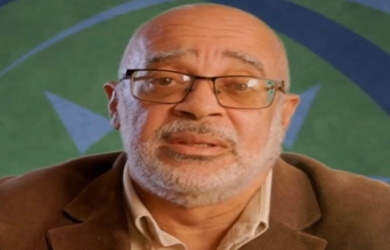
CASTRIES, St. Lucia, Jun 10, CMC – Director General of the Organisation of Eastern Caribbean States (OECS), Dr. Didacus Jules, Wednesday urged sub-regional countries to move faster towards cementing the aspiration of the OECS integration process, warning that the global geopolitical landscape is shifting in ways that are profoundly consequential for small states.
Jules, addressing a webinar on Contingent Rights within the OECS, said this is not a conversation about what member countries have already agreed to, noting that the relevant agreements exist and treaties signed and the frameworks are in place.
“What we are here to talk about today is whether any of it is actually working for the people it was designed to serve. We are meeting at an extraordinary moment. The global geopolitical landscape is shifting in ways that are profoundly consequential for small states.”
Jules said that supply chains are being disrupted and trade relationships are being reconfigured.
“The global consensus on multilateralism that once provided a degree of predictability for nations like ours is fraying. Climate change is no longer a future threat. It is a present reality that is displacing communities and reshaping economies all across our region.”
Jules said that in this environment, deeper regional integration is “not a luxury or an aspiration.
“It is a survival imperative. Our individual economies are too small. Our resource bases are too limited and our exposure to external shocks too great for us to navigate what is coming as isolated nation states.
“The OECS Economic Union is not merely a policy project. It is a strategic necessity. If we do not use this moment to accelerate and deepen integration, we will find ourselves individually overwhelmed by forces we could have collectively managed.”
He said 16 years ago, the leaders of the sub-region established the Eastern Caribbean Economic Union through the revised Treaty of Basseterre, adding “it was a landmark achievement
‘”The legal and institutional architecture we built represents one of the most advanced frameworks for regional integration in the Caribbean, indeed in the developing world.
“But I want to be direct with you. Legal frameworks do not move people. Treaties do not open borders. Model bills do not protect families. People do. Officers do. Institutions do. “
But he noted that right now, the gap between what have been enshrined in the agreements agreements and what citizens actually experience when they move across this region remains far too wide.
“OECS citizen who relocates to another member state should be able to access healthcare, education for their children, and social protection without running a bureaucratic gauntlet.
“A third-country national spouse should know with certainty what rights they hold. A border officer should apply the same standards regardless of which port of entry they staff. These are not aspirational statements. They are legal obligations we have already accepted. We simply need to fulfil them.”
The OECS Director General said that the inconsistency is not theoretical.
“Citizens are experiencing it today. They are being turned away at ports of entry. They are being told that documents are insufficient when they are not. They are being denied access to services that are rightfully theirs.
“Every such incident is a failure, not just an administrative failure, but a failure of will to translate commitment into practise. We have done enough talking about rights. It is time to operationalise them.”
Jules said that the St. Lucia-based OECS Commission has done considerable work including the Contingent Rights Policy, the model bill approved by the OECS Assembly in June 2025, border modernisation initiatives, capacity-building programmes for frontline officers.
He said the institutional groundwork is being laid, but the work is incomplete and the urgency is real.
“Today, I wish that this webinar would move us beyond diagnosis and towards accountability. The panellists assembled here bring expertise from immigration, humanitarian response, climate mobility, legal compliance, and regional governance.
“They are not here to describe the problem. We know the problem. They are here to help us identify what will it concretely take to close the gap. I want us to leave today with a shared and frank assessment of where the bottlenecks are, whether they lie in legislation not yet enacted, in training not yet delivered, in data systems not yet connected, or in political will not yet fully committed.”
Jules urged the panel to be honest about which of those bottlenecks can be broken within the next 12 months, reiterating that the measure of the OECS Economic Union is not found in our treaties.
“It is found in the experience of an ordinary OECS citizen, a nurse who moves from Grenada to St. Lucia and is treated with dignity at the border. A family that reunifies across our islands without losing access to schooling or healthcare. A worker who crosses member state lines in pursuit of opportunity without administrative barriers that belong to another era.
“That citizen is watching us, not our frameworks, us. The question this webinar must help answer is a simple one. What will it take and who will do it? Let us have that conversation, honestly, frankly, and with the urgency that this moment demands,” Jules added.
The OECS groups the islands of Antigua and Barbuda, Dominica, Grenada, St. Lucia, St. Vincent and the Grenadines, St. Kitts and Nevis, Montserrat and Anguilla.
CMC/jh/ir/2026