
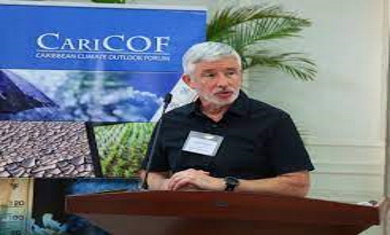
BRIDGETOWN, Barbados, Jan 26, CMC – The chief climate scientist of the International Research Institute for Climate and Society (IRI) at Columbia University, Dr. Simon Mason, says over the last few years, scientists have been able to predict heavy rainfall and dry spells at least four weeks in advance.
Mason told a two-day that brought together experts in the that “these so-called sub-seasonal forecasts will become routine from some of the leading global centres early in 2024.1.26
“There have been some exciting developments in the last few years in the science-community’s ability to predict heavy rainfall and dry spells two to four weeks in advance,” he said, with the delegates being told that the Barbados-based Caribbean Institute for Meteorology and Hydrology (CIMH) has been anticipating these developments, and after a series of research and training activities, roduced its first ever experimental sub-seasonal forecast at the most recent Caribbean Climate Outlook Forum held in Dominica in November last year.
“Such forecasts provide valuable potential to improve water-resource management and flash-flood control in the Caribbean region, but collaboration with the water management community is required to ensure that the forecasts are adapted, designed and interpreted to maximise their benefit,” Mason said, adding that the workshop provided “ an excellent opportunity to take these important next steps to strengthen resiliency in the region”.
The workshop, which ended on Thursday, was organised under the Intra-ACP GCCA+ Programme in the Caribbean: Enhancing Climate Resilience in Caribbean Forum (CARIFORUM) countries led by the Caribbean Community Climate Change Centre (CCCCC). It was hosted by the CIMH in collaboration with the IRI, with support from the European Union (EU).
CIMH principal, Dr. David Farrell, said the workshop provided an invaluable platform for water managers and meteorological services to enhance their understanding of sub-seasonal to seasonal forecasts and the importance of these forecasts for predicting water availability at sub-seasonal and seasonal scales.
“By collaborating with our partners in the CARIFORUM countries, the CCCCC, and the IRI, we are strengthening our capacity to address climate resilience and improve water resources management in the region,” Farrell said, thanking also the EU for its support of the Intra-ACP GCCA+ Programme in the Caribbean.
The lead project manager at the Belize-based CCCCC, Ansel Dubon, said that the activities, inclusive of the workshop, being undertaken by the CIMH and IRI are essential to achieving the overall objective of the GCCA+ programme, which is to reduce risks and vulnerabilities from climate change to human-made and natural assets in CARIFORUM countries.
“We look forward to the various officers who participated in the training applying the new capacities to benefit the supply of water in their respective countries and by extension, the region,” he added.
The organisers said that it is hoped the workshop will support informed decision-making and catalyze the collaborative efforts required to address climate challenges, improve water resources management, and enhance resilience in the Caribbean region.
CMC/ag/ir/2024