
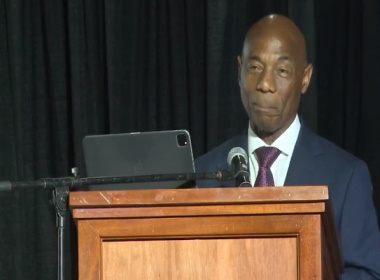
ST. JOHN’S, Antigua, Aug 15, CMC – President of the Barbados-based Caribbean Development Bank (CDB), Dr. Hyginus ‘Gene’ Leon, has told regional broadcasters that communications have and should play a strategic role in promoting social justice and holistic development.
Delivering the feature address at the 54th annual general meeting of the Caribbean Broadcasting Union (CBU) here on Monday night, Leon sought to explore the role of the fourth estate in the 21st century as guardians of social justice in small developing societies.
He argued that if there is acceptance that social justice exists when “all people share a common humanity and therefore have a right to equitable treatment, support for their human rights, and a fair allocation of community resources “wouldn’t it be appropriate to declare that there cannot be development of a nation without social justice of its people.
“Indeed, social justice promises change, increased access to rights and dignity, and maximization of the potential of a people,” Leon said, adding that the theme of social justice is fully aligned with the CDB’s advocacy of a holistic, systems approach to development.
He said the region’s premier financial institution advocates for two key principles to underlie all policies aimed at influencing behaviours for advancing development trajectories, namely sustainability, based on strengthening resilience, and inclusivity, based on narrowing inequity.
Leon told the regional and international broadcasters that in some developed countries, the role of the media is so highly valued that it is enshrined in the constitution.
“While it is under attack in many of those same countries and media practitioners have been branded “enemies of the people”, thankfully we have not reached that level of dogma here in the region.”
The St. Lucian-born economist said that the coronavirus (COVID-19) pandemic has shown that inequalities among populations are driving the tensions that are seen and reported upon in the region.
He recalled a 2021 UNDP Report that states that regardless of decades of progress Latin America and the Caribbean region (LAC) “remain the second most unequal in the world and countries in LAC exhibit higher income inequality than those in other regions at similar development levels”.
Leon said that this statement begs the question, so what are these inequalities and how can they be deconstructed and disseminated to a weary audience tired of living the reality of the statement.
He said the media landscape has always been replete with courageous men and women who have placed their beliefs on the line and their very lives at risk, to advocate for the rights and dignity of others.
Leon said that while there have been international situations, the Caribbean region is replete with stories of journalists who covered stories often at their peril, recalling the work of the Trinidadian journalist, Jones P Madeira, who had been held captive when a group of Muslimeen sought to overthrow the Trinidad and Tobago government in 1990.
“Today, we are at that point in our history where we need to decide what’s important for our future and how do we share this message to grow? How do we revive the spirit of these pioneers?
“Some may declare, and probably correctly, that many media houses have highlighted some of the ills of society, but I would argue that media reflects the context in which it exists. What is the obligation of Caribbean media in the current development crisis that confronts us? “
Leon said to be clear, the media landscape has evolved, away from government-owned to mostly private owned establishments and that the global economic, social, environmental, and political landscape has seen swift and intense shifts.
“In the last three years alone, the region has seen a global pandemic, economic shocks, and a struggle to return to the path of development goals and resilient prosperity. In small, vulnerable states, Caribbean media are particularly important to support relief and recovery efforts as well as disaster mitigation.
“But I fear the industry is not doing enough to educate and inform its audiences on various platforms about the multiplicity of challenges and changes that are and will continue to impact lives and livelihoods. Today, I’d like to ask what is the media’s moonshot project that will attract the interest of our people and be a call to action for behaviour change? “
He said two areas of interest come to mind namely crime and misinformation.
“On any given day across the region, we would be hard pressed not to find a chronicling of rising crime and violence. What is missing, is greater analysis into the causes of these crimes and the ripple effects across other sectors of society.
“I propose seeing violence not just as an opportunity to rush to social media first with pictures and text – the usual concept of “if it bleeds it leads”. Also, we may ask shouldn’t the media share the responsibility of promoting social justice and thereby development by assisting in reducing systemic tensions that arise from social inequities?”
Leon urged the broadcasters to consider that in small societies, often with one hospital, each gunshot victim stalls the level of care available to other patients.
“The staff on duty in the emergency space focus all resources to save the life of that patient, whether victim or perpetrator, meanwhile patients with other injuries are triaged and put to wait, often for many hours and sometimes days.
“These gunshot wounds and other victims of crime increase the cost of health care, constrain other fiscal spending, and could necessitate citizens paying more taxes to support health institutions.”
But he said that gun crimes impact the general sense of safety for the society. Leon said businesses close early because citizens avoid shopping late and staff need to get home.
“That reduces productivity and economic activity. People who participate in outdoor exercise and activities tend to do less, the knock on effect of less physical activity, coupled with poor eating habits, increases already rising levels of chronic non-communicable diseases (NCDs). “And yet to be measured is the impact of lack of safety and social cohesion on mental health, and ultimately on the health care bill of the nation.”
He said while he was not advocating that the media stop reporting on crime, however, the “reporting must be accompanied by more analysis of the issues so that the citizens are aware of what drives these crimes and what work is being done by governments and civil society to reduce or mitigate crime.
“We cannot become desensitised to rising crime rates because they are not happening in “my” neighborhood. Narratives that suggest many of the offences happen in lower-income communities and are drug-related retaliatory actions between crime factions must be demystified.
“Eventually if we are not vigilant, crime comes to all our neighborhoods,” Leon said, reminding the audience “the police and the state cannot solve crime on their own.
“Crime is not a phenomenon for someone else to tackle but one for all of us to tackle. And we do this by our contributions to the cause of advancing social justice.”
Regarding misinformation and disinformation, Leon said this is an area that has the potential to truly set back the development trajectory.
“It is an area where the media has an enormous amount of leverage. The ubiquitous smartphone with its capacity to create and send content has changed our lives in ways that we could not have imagined fifty years ago.
“We saw it ourselves during the COVID-19 pandemic where people believed information sent to them via voice note or that they found while doing their own research that sent them down a rabbit hole of conspiracy theories. “
He said in December last year, Public Media Alliance (PMA) published an action plan to combat misinformation and disinformation for Caribbean media workers that included the need for more regional research and analysis to combat “disinformation, media literacy, and trust in news media”.
He said in order to solve a problem, there is need to identify the issue and commit resources to put an end to it.
“What work is the media doing to reduce the misinformation and disinformation that is now part of our daily landscape? Too often media houses are refuting this information with an audience that sees traditional media as not responding fast enough to issues arising in their communities.
“In the past, news agencies such as CANA (The Caribbean News Agency) worked with media houses across the region to distribute stories that were fact checked and researched. Today, international newspapers have set up divisions dedicated to this process and in some instances have titled segments in their newscasts and other media products dedicated to identifying truth, giving the audience an alternative to voice notes and video without context.’
Leon said that the development of Artificial Intelligence (AI) will make the harnessing of misinformation and disinformation even more urgent and has implications for the future of the media industry.
He said the challenge is to harness the research capability and access that AI produces while using the human thought to engineer value-addition to the output produced by AI — a win-win situation.
“We suggest that media houses begin to prepare not only their businesses but the rest of the region for the impact of AI on industries, opportunities for upskilling to different areas (job loss minimization), and determine what tasks are best left for AI such as research in digitized news libraries.
“You may ask what about content? Across the region, there are many reels of film, tapes, audio recordings, and newspapers deteriorating in poorly temperature-controlled rooms, while the machinery needed for playback is either obsolete or prohibitively expensive to purchase by one media house.
“What can we do next? Imagine the region as one vast digital archive that has recorded the social history of our region, a resource largely untouched.
“Now imagine that the region’s media houses collaborated to digitize that resource and use it as a revenue generator where for a small fee to each other, and a larger one to those with deeper pockets, the material could be re-purposed, through AI, to lend deeper context to stories, features, documentaries, and to widen the development narrative,” Leon told the broadcasters.
CMC/pr/ir/2023