
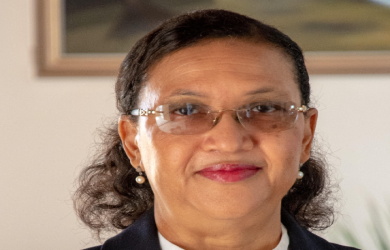
KINGSTON, Jamaica, Jun 1, CMC -The 12th Annual Conference of the Commonwealth Caribbean Association of Integrity Commissions and Anti-Corruption Bodies (CCAICACB) began here on Monday with delegates seeking to strengthening regional integrity efforts and anti-corruption mechanisms in an evolving global environment.
CCAICACB chairperson, Anande Trotman-Joseph, acknowledging that while this “work will take an eternity…we go, continuously, as we engage on pressing challenges and opportunities facing the world and by extension our own organisations”.
She told the conference being held under the theme “Strengthening Regional Integrity Efforts and Anti-Corruption Mechanisms In An Evolving Global Environment,” that geopolitical and geoeconomics impacts may create an atmosphere of fear and anxiety, a perfect backdrop for corruption in the absence of peace.
“The effects of wars in several global theatres impact our own region’s economies, resulting in what we all know, rising prices at the gas pumps, food prices escalating in our supermarkets and even our own war theatre in the Caribbean in a war against drugs resulting in many Caribbean casualties.
“But as we focus on corruption, grand or petty, it is more than temptations of greed, expediency and favour. The type of public corruption that our agencies target is usually systematic, embedded in our social and political cultures, ways of doing business, our procurement systems, and yes, public-private networks.
“Because somebody is doing the corrupting, and that is what we have to discuss more during these next few days. Lest we here gathered forget, become complacent, negligent or desensitised, I remind us all, we know it already, but corruption is a crime.”
Trotman-Joseph said that activities related to corruption are criminal, and the gains of corruption are proceeds of crime.
She said the Inter-American Bank reports that overall government spending, waste, encompassing procurement, fraud and corruption, and institutional inefficiencies cost Latin America and the Caribbean roughly 4.4 per cent of its combined gross domestic product (GDP), amounting to billions of US dollars annually.
“This ratio is far more for some individual Caribbean countries,” she said, warning “allowing corruption and its systems to flourish will undermine the development of our region, and of course our nations.
“Corruption will rob our populations, especially vulnerable groups of our society, of healthcare, education, and all of us, of the good life that is promised to us. Therefore, effectively tackling corruption requires more than lip service. More than lip service.
“Yes, we have laws, but many of these laws are gathering cobwebs on the legal shelves. Responses require political will. Yes, leadership will. All those of us in leadership of organisations like this regional one, and in our national anti-corruption and integrity organisations, leadership will”
She told the delegates that however, it’s not all doomsday.
“Armageddon or all lost. There are tools in the arsenal for this fight. Most Caribbean territories have ratified international regional treaties, such as the international UN Convention Against Corruption. Most nations have ratified this.
“Also, we have embraced international guidelines and best practises, such as the OECD (Organisation for Economic Co-operation and Development) and FATF (Financial Action Task Force) guidelines, the Commonwealth Anti-Corruption Benchmarks, and we are under oversight through the Mississippi and UNODC and CATF mechanisms.”
She said that the shared best practises of the members have informed that the effective fighting of corruption is more than an integrity commission receiving static asset declarations as if they are postal offices.
“The scope, obligations, and purpose of our international and national laws require effective compliance, investigations, prosecutions, and asset recovery processes. So, I suggest to us that we cannot continue operating in many cases in national silos of secrecy, but we must act in a joined-up way in our thinking and our actions in round-table activities involving a wider range of stakeholders so that we can implement national anti-crime and anti-corruption strategic plans.
This will be achieved only through behavioural change, very hard to achieve. Therefore, we must adopt a life-cycle approach. This is the collective quest of culture shifting and building public trust. We must be a community in action.”
Trotman-Joseph said that there is need for a collective voice so as to push that initiative, adding that the three day conference provides an opportunity to further “discuss the challenges that for all of our established entities, our resolutions, and our demands that are so repetitive, demanding substantive independence of our integrity commissions and anti-corruption entities to get our work done.
“We are repeating the demands around inadequate and insufficient financial, human, and plant resources for ably fighting corruption. We too must sharpen our advocacy and deepen our communications with governments, cabinets, oppositions, parliamentarians.
“We have to widen our own networking in a very efficient way internally and bilaterally and multilaterally. So, our governments and our populations want tangible evidence that the investments of taxpayers’ monies lead to prosecutions, lead to calling out breaches of codes of ethics and conduct as would be embedded in our integrity legislation.
“They want to see asset recoveries. When the money goes out, why is it not coming in? Why is it not going back into the treasury? This is what our peoples across the region want to see,” Trotman-Joseph said, adding that “jail doors have begun to clang” in the region.
She noted that last week, the former premier of the Turks and Caicos Islands, Michael Misick was sentenced to prison four years and 26 days after being convicted on bribery charges in a landmark corruption case that has spanned more than a decade….
“The jail doors have clanged in the British Virgin Islands (BVI),” she said, noting that the former premier Andrew Fahie, who was jailed for 11 years and three months, in the United States for attempts to stage corrupt activities in the BVI.
Meanwhile, chairperson of the Integrity Commission of Jamaica, Justice Carol Lawrence Beswick, told delegates that if “litigation is designed to stymie our efforts, then that’s another matter with which we have to deal.
“But we shall not be thwarted. Understanding why corruption occurs is fundamental to strategising as to the best approaches to eradicate it. We have to know what we’re dealing with. Where is it coming from?
“We therefore recognise that as part of our work, we must pay attention to the human element involved in corruption,” she said, adding “this conference will play a major role in helping us in the Commonwealth Caribbean work more efficiently and more effectively in the anti-corruption sphere.
“Let us therefore resolve to leave this conference even more united as an association. Stronger in our determination to fight this beast called corruption, with every skill we have, with all the will and all the fervour that we can muster, let us fight.
“Let us use every technological advance, of course doing that within the current parameters of the law. And so my Caribbean friends and colleagues, I welcome you. I see this conference as being so important to us all individually and collectively,” she added.
CMC/ag/ir/2026