
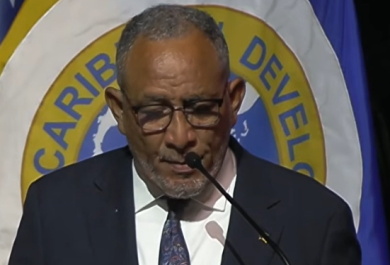
NASSAU, Bahamas, Jun 3, CMC -St. Vincent and the Grenadines Prime Minister Dr. Godwin Friday, Wednesday said that borrowing member countries (BMCs) of the Barbados-based Caribbean Development Bank (CDB) face a challenging economic environment characterised by persistent structural vulnerabilities, tightening global credit conditions and severe climate shocks.
He said that central governments’ debt remains “chronically high”, with debt to gross domestic product (GDP) ratios exceeding the prudential 60 per cent target in nine member countries, including his own, which exceeds 113 per cent.
“This high debt burden severely limits borrowing countries’ ability to fund necessary investments to accelerate economic growth and protect the most vulnerable of our citizens,” Friday said, adding “we face tightening supply chains, rising shipping costs, escalating fuel prices and high costs of living”
Addressing the opening ceremony of the 56th annual meeting of the board of governors of the CDB, Friday said that these problems are associated with the Middle East war, but even so, the region would still be facing difficult economic conditions.
“We are further constrained by a challenging international aid environment. Official development assistance from partner governments has experienced a marked decline, exacerbating the critical financing gap. Watch video
“Caribbean nations are forced to do more with less. At a time when the region requires an estimated US$14 billion annually for comprehensive climate response, it mobilises less than 10 percent of that amount.”
Friday said that it is therefore imperative that the region’s development partners become more adaptive, more responsive, and willing to provide highly concessional financing and dedicated resources for loss and damage that will not worsen a bad debt situation”
He said that there is acknowledgement that the CDB is an indispensable partner in the project of regional economic transformation promised upon regional integration.
“However, regional economic integration is sustainable only if partners all derive benefit from it and economic disparities among member countries do not grow too wide. The bank is uniquely positioned to promote that end.”
Prime Minister Friday said that the CDB ass the only multilateral development bank whose core constituents and owners are the Caribbean people, has through decades of working directly in this space, developed a wealth of experience, talent, and invaluable knowledge about regional countries.
“The bank has become indispensable to our development. Consequently, the CDB is well-placed to speak credibly and in a focused manner for its Caribbean constituents and to be in the lead in designing solutions tailored to the needs of our economically and climate-vulnerable small, open economies.”
He said a striking demonstration of this transformative impact is observed in St. Vincent and the Grenadines, which after decades of repeated severe shocks have seen efforts to develop resilient infrastructure.
He said that these interventions prove that when targeted CDB capital is merged with local knowledge, it has the power to transform lives, elevate communities, and build climate-resilient economic assets.
But he said to safeguard Caribbean futures, the borrowing member countries call for greater collaboration in building resilience in a comprehensive way, spanning environmental, economic, and social dimensions.
“This comprehensive resilience framework must guide the bank’s operational priorities in the years ahead,” he said, noting that the Caribbean has entered the 2026 hurricane season, still nursing severe wounds inflected by Hurricanes Beryl in 2024 and Melissa in 2025.
“We are familiar with the enormous economic toll those extreme weather events extracted and therefore must respond effectively. The environmental strategy of the CDB and borrowing countries must focus on building climate resilience, economic assets, upgrading coastal infrastructure, and expanding early warning systems.”
Friday, who came to office in November last year, said that the CB’s Climate Change Project Preparation Fund is critical in dissolving resource bottlenecks, enabling timely and enhanced capital flows for adaptation.
“Economic resilience requires that there be support for countries that absorb shocks while sustaining inclusive growth. The borrowing member countries must aggressively pursue economic diversification across modern frontiers, including digitalising public services, reducing high fossil fuel imports by exploiting renewable energy sources such as the geothermal projects in Dominica and St. Kitts-Nevis, and investing aggressively in solar power, promoting sustainable use and management of our marine resources, and promoting value-added agro-processing to enhance domestic food security.”
He said that there is also a need to reduce food imports, and encourage export., saying “growth is misguided and unsustainable if it leaves vulnerable populations behind.
“Social resilience requires strengthening people’s ability to withstand shocks by expanding access to essential services and developing responsive and effective social protection systems.”
Friday said that key initiatives like the Basic Needs Trust Fund must continue to act as flagship community development programmes, creating inclusive, safe environments across participating countries.
He said BMCs express their support for the CDB’s institutional Reform Agenda, known as CDB Forward, which envisages reforms in governance, in addressing the implementation deficit or gap, workforce considerations, making the bank’s operating model more proactive and client-centred.
“Considering our structural challenges in the region, the bank must make its development impact felt with greater speed and with far more reach. The borrowing member countries have delivered a clear mandate. We must move swiftly to implement the transformative reforms to eliminate friction and drive our institution forward.
“The need is urgent, and therefore the time to act mis now. The borrowing member countries urge the bank to accelerate project implementation, address the persistent issue of undisbursed loans, and reform its procurement frameworks by adopting digital tools and risk-based approaches.”
Friday said that the BMCs were also encouraging the CDB to aggressively embrace and leverage partnerships with other multilateral development banks, as well as bilateral development partners, to mobilise private capital and maximise co-financing.
“To sustain this ambitious agenda, the borrowing member countries appeal directly to all CDB shareholders and non-regional partners to fully support the bank in its strategic direction. The 10-year strategic plan requires robust capital backing and expanded resources.
“In this regard, full support must be given to the Special Development Fund, which remains the lifeblood of concessional financing for the region’s vulnerable members. ”
Friday said that resistance, adaptation, and an unconquerable spirit define the historical experience of the Caribbean people and “despite our limitations, we continue to deliver better lives for our people.
“However, the region’s development path must not be defined or be limited by our vulnerability. It must be shaped by our deliberate choices, our capable institutions, and by regional solidarity,” he said, recalling the words of the CDB’s first president, Sir Arthur Lewis, that Caribbean people can solve their own problems, but first they must find the secret that will put hope, initiative, direction, and an unconquerable will into the management of their affairs.
Download video – Prime Minister Dr. Goodwin Friday
CMC/pr/ir/2026