
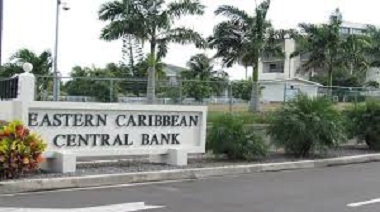
BASSETERRE, St. Kitts, Jul 2, CMC- The Eastern Caribbean Central Bank (ECCB) says it has recorded a profit of EC$121.6 million (One EC dollar=US$0.37 cents) for the financial year, which ended on March 31, according to its annual report released here.
The ECCB said that the performance also highlighted the resilience of the Eastern Caribbean Currency Union (ECCU) “amid a year of heightened global uncertainty and outlining an ambitious roadmap for transforming the region’s economy over the next decade”.
 ECCB Governor, Timothy Antoine, reflecting on the year and the path ahead, said that “the journey ahead will require courage, discipline, innovation, and collective action.
“Yet I remain deeply optimistic about the future of our Currency Union,” he added.
The report notes that the ECCU economy recorded estimated growth of 2.5 per cent in 2025, supported by continued strength in tourism and infrastructure investment. Inflation moderated during the latter part of the year, while the region’s financial system remained stable and resilient.
According to the ECCB’s 2025-2026 Annual Report, the profit represented a modest decline of $4.7 million, or 3.7 per cent, compared with the $126.2 million earned in the previous financial year.
But the ECCB, which on July 7, celebrates the 50th anniversary of the EC dollar being pegged to the United States dollar, noted that despite the slight reduction, has described its performance as another year of solid financial results, underpinned by continued balance sheet growth and stronger investment.
The ECCB, which serves as a central bank for the islands of Antigua and Barbuda, Dominica, Grenada, St. Lucia, St. Kitts and Nevis, St. Vincent and the Grenadines and Montserrat, said that operating income rose by $14.8 million, or 6.7 per cent, to $236.4 million, driven largely by a $14.7 million increase in net interest income.
It said that the improvement reflected higher yields earned on the ECCB’s foreign reserve assets as global interest rates remained favourable. However, operating expenses climbed by 20.1 per cent to $117.4 million, up from $97.7 million in the previous year.
The increase was attributed mainly to lower recoveries on impaired financial assets, higher administrative and general expenses, increased staff costs, and greater depreciation expenses.
The report noted that administrative costs rose because of increased spending on information technology upgrades, software support and maintenance contracts, while salaries and staff benefits increased following the recruitment of additional personnel during the year.
According to the ECCB’s annual report, the institution’s financial position also strengthened, with total assets rising by $544.3 million, or 8.9 per cent, to $6.68 billion as at March 31, 2026. The ECCB said that the growth was driven primarily by an increase in foreign reserve assets, which expanded by $503.5 million to $5.99 billion.
It said that the rise reflected higher holdings in money market instruments and money at call, fueled by inflows from loans disbursed to participating governments by regional and international institutions, as well as purchases of regional and foreign currency notes from commercial banks.
Domestic assets also increased by $40.8 million to $694.3 million, supported by additional lending to participating governments, growth in pension assets and continued investment in property and equipment. Total liabilities increased by $506.8 million to $6.16 billion, largely due to higher currency in circulation and increased balances in participating governments’ operating and call accounts. The increases were partially offset by a decline in bankers reserves and lower foreign demand liabilities.
Meanwhile, the ECCB’s equity position improved, with total equity increasing by $37.5 million, or 7.8 per cent, to $520.5 million. The growth reflected allocations from the year’s profit to the Bank’s general reserve, as well as gains in its pension reserve resulting from strong investment performance of its defined benefit pension plan.
CMC/h/ir/2026.