
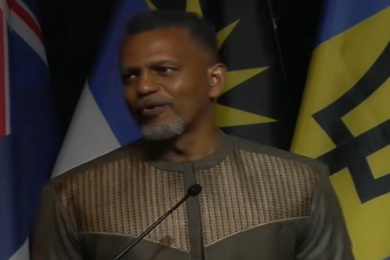
NASSAU, Bahamas, Jun 3, CMC -President of the Barbados-based Caribbean Development Bank (CDB), Daniel Best, Wednesday, called for a Caribbean that is stronger, greener, more resilient, inclusive and more prosperous even as he acknowledged that the “challenges we face are real, but so too is our capacity to overcome them together”.
Addressing the 56th annual meeting of the CDB board of governors, Best said that the meeting is taking place in a world marked by geopolitical fragmentation, climate volatility, technological disruption, public health risk, and shrinking development finance.
He told the question now is how to build a stronger Caribbean in uncertain times, noting that uncertainty is not new to the region.
He said that the theme of the conference “Forging the Caribbean’s Future, Strategic Solutions for Uncertain Times,” allows for the isolation of challenges and issues, identifying innovations and solutions and implementing actions to support meaningful change, and build permanent partnerships.
“These efforts will drive meaningful impact that will help the bank to innovate, transform, and thrive,” he said, adding that the CDB recognises that many of the challenges the region faces are not new “but they are being intensified by a rapidly changing global landscape.
“The impacts of climate change are now more pronounced than ever before,” he said, recalling a visit Jamaica in the immediate aftermath of Hurricane Melissa last October.
“…what I witnessed was nothing short of gut wrenching. Communities flattened, homes gone, and a hospital barely standing. And yet within those damaged walls, nurses and doctors pressed on, working tirelessly to care for the injured. Because that is who we are as a region. “We persevere even in the face of devastation. At the same time, the changing global landscape is amplifying external shocks and geopolitical tensions. And their effects are reaching our shores with increasing speed and intensity.
“We see it in rising oil prices. We feel it in supply chain disruptions that threaten our food security. Uncertainty is now the norm. And as we become more interconnected, the pace of technological disruption is transforming all aspects of our economies and societies.”
Bert said that since 2025, the CDB has approved and disbursed in excess of US$400 million to advance critical infrastructure, strengthen educational outcomes, support climate change and disaster response, and strengthen the development of the private sector across the region.
“We achieved a record US$226.7 million in climate finance commitments while mobilising new resources through the Green Climate Fund (GCF). Notably, three CDB-led GCF proposals were approved, including the first single-country GCF project right here in the Bahamas, strengthening water security and resilience to future storms. Across the region, we are driving impact at scale.”
Best said that in partnership with Inter American Development Bank (IDB) and regional governments, the CDB is leading a unified effort to retrofit homes in more than 15 countries, transforming vulnerable housing into resilient shelters and protecting millions of Caribbean families from climate shocks.
He said at the community level, resilience continues to grow and through the Basic Needs Trust Fund, 92 projects have been completed across nine countries, with a new US$53.6 million cycle approved.
“But we are not stopping there. Our new 10-year strategic plan, 2026 to 2035, is anchored, as you have heard, in social, economic, and environmental resilience, because resilience must shape every investment we make.
“To translate this into action, we are focussing where it matters most. First, our youth. Nearly half of our population is under the age of 30. Yet too many remain disconnected from opportunity. This is not just a social challenge. It is an economic one.”
Best said that the CDB’s strategy prioritises skills, entrepreneurship, and access to finance so that young people can build their futures.
Best said that the CDB is also supporting other projects in the region including an institutional diagnostic and governance reform programme for the Development Finance Corporation (DFC) strengthening its operations, governance, and long-term sustainability.
“Today, DFC is a leading development finance institution in Belize, supporting private sector development through business lending, mortgage financing, and student loans,” Best said.
He said that the CDB Forward initiative will position the bank to serve the Caribbean with greater purpose, credibility, and impact in a decade that will demand nothing less.
“Friends of CDB, as we look ahead to this week, we recognise that in a world defined by uncertainty, we must go further. We must move from commitment to execution because uncertainty demands strategic solutions.
“This meeting is intentionally designed not just for dialogue but for results, building partnerships, and advancing implementations. Our seminars are no longer just discussions. They are solution labs focused on delivering practical responses to real challenges.”
He said the annual William G. Demas Lecture continues to anchor the CDB’s thinking, challenging it to rethink development in a rapidly changing world.
“But the true strength of this meeting lies in its people. Governments, the private sector, IFI partners, civil society, academia, and voices too often unheard. Because inclusive solutions are the only ones that will ultimately endure.”
“So let us leave this meeting with urgency. Let us leave with purpose. Let us leave with a renewed commitment to partnership. And let us leave determined to build a Caribbean that is stronger, greener, more resilient, more inclusive, and more prosperous than the one we inherited.”
CMC/pr/ir/2026