
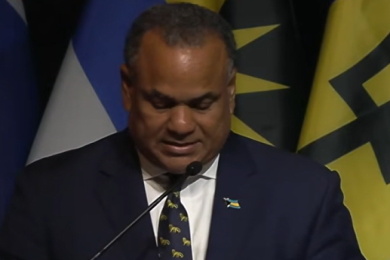
NASSAU, Bahamas, Jun 3, CMC – Bahamas Economic Affairs Minister, Michael Halkatis, Wednesday said the future of the Caribbean cannot be built solely in parliament chambers or conference rooms and that it must also be shaped by various stakeholders, including entrepreneurs, educators, farmers, artists, researchers, innovators and labour leaders.
Addressing the opening ceremony of the 56th annual meeting of the board of governors of the Barbados-based Caribbean Development Bank (CDB), Halkatis said that the future also requires collaboration between the public sector and private sector, between academia and industry, and between civil society and policymakers.
“The challenges we face are interconnected, and therefore, our solutions must also be interconnected,” he said, adding that there must also be a role for young people at the centre of regional development. Watch video
The meeting here is being held under the theme, “Forging the Caribbean’s Future: Strategic Solutions for Uncertain Times,” and the Halkatis, who is also the chairman of the board of governors, said across the Caribbean, young people are already leading change.
“They are launching businesses, driving technological innovation, advancing for climate justice, building creative industries, and reimagining what Caribbean leadership can look like. Yet, too many young people still face unemployment, migration pressures, limited access to financing, and unequal educational opportunities.
“We cannot speak about forging the future while excluding those who will inherit it. And therefore, we must invest intentionally in education, digital skills, entrepreneurship, research, and leadership development,” he said, adding “we must create pathways for young people not only to participate in the economy, but to lead it”.
Halkatis said that the future Caribbean economy will be powered not only by natural resources, but by human creativity, digital innovation, and knowledge-based industries.
He said artificial intelligence, digital finance, renewable technologies, and global connectivity are rapidly transforming the global economy.
“If the Caribbean fails to adapt, we risk being left behind. But if we embrace innovation strategically, we can position ourselves competitively in a changing global environment. Digital transformation can improve health care, education, governance, (7:23) trade, and financial inclusion. Technology can help small businesses access global markets.”
Halkatis said that innovation can strengthen disaster preparedness and modernise public services.
“However, technological progress must be inclusive. We must ensure that rural communities, small island states, vulnerable populations, and underserved citizens are not excluded from the benefits of modernisation.”
He said true development is measured not only by economic growth, but by whether people feel safer, more empowered, and more hopeful about their future.
“Ladies and gentlemen, the Caribbean also faces serious economic vulnerabilities that demand strategic solutions. Most of our economies remain heavily dependent on tourism, imports, and external markets,” he said, noting that global disruptions, from pandemics to supply chain crises to geopolitical conflict, have shown us the danger of over-dependence”.
Halkatis said that economic diversification is therefore no longer a luxury, but is a necessity.
“We must strengthen agriculture and food production. We must support small and medium-sized companies. We must deepen regional trade. We must invest in manufacturing, logistics, renewable energy, financial services, and the creative economy.
“We must also advocate for fairer access to global financing systems that recognise the unique vulnerabilities of small island developing states,” he said, adding that Caribbean institutions and international leaders continue to call for reforms to global financial systems that better account for vulnerability, resilience, and sustainable development needs.
“Too often, our countries are classified as middle-income while carrying overwhelming debt burdens and facing repeated climate disasters. Traditional measurements fail to capture the true realities of vulnerability in our region.”
Halkatis said that the Caribbean deserves development systems that are “fair, equitable, and responsive to our circumstances.(
“But even as we advocate globally, we must also act regionally. We must strengthen governance, transparency, and institutional capacity. Strong institutions create investor confidence. Strong institutions improve service delivery. Strong institutions help societies withstand crises and maintain stability during uncertain times.”
The Bahamas Economic Affairs Minister said that the Caribbean development leaders continue to emphasise institutional strengthening as essential to resilience and long-term prosperity.
“But most importantly…we must maintain faith in ourselves. The Caribbean ever lacked brilliance. We have produced world-renowned scholars, athletes, artists, scientists, innovators, and statesmen.
“Our cultural influence extends far beyond our geographic size. Our people continue to achieve greatness on every continent. What we need now is the confidence to believe that Caribbean solutions can solve Caribbean challenges.
“The future we seek will not arrive automatically. It will require vision, it will require sacrifice, it will require courage, and it will require partnership. But history has already shown us that when the Caribbean moves with purpose, extraordinary things happen.”
He told the delegates that the meeting here provides an opportunity “commit ourselves to more than dialogue.
“Let us commit ourselves to action. Let this ceremony mark the beginning of a renewed collaboration. Let it inspire innovative thinking and strategic partnerships. Let it strengthen our determination to confront uncertainty, not with fear, but with confidence and resolve.
“The Caribbean stands at a defining moment. The choices we make today will shape the opportunities available to future generations. They will determine whether our societies become more resilient or more vulnerable, more inclusive or more divided, more sustainable or more fragile.”
Halkkatis said he remains optimistic because he believes in the strength of Caribbean people.
“I believe in our resilience. I believe in our ingenuity. And I believe that even in uncertain times, the Caribbean possesses the power to forge a future of dignity, sustainability, unity, and shared prosperity,” he said, adding “together, we can forge the Caribbean future we deserve”.
CMC/pr/ir/2026