
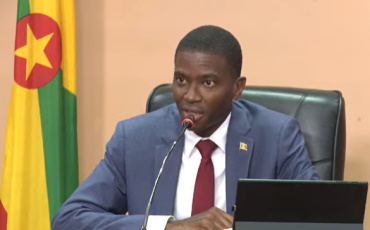
WASHINGTON, Jun 1, CMC – Grenada’s Prime Minister Dickon Mitchell Friday said that Disaster Risk Reduction (DRR) is no longer an option and is a reality that must be tackled with determination and strong political will.
Addressing the virtual forum organised by the Washington-based Atlantic Council on the theme “Strengthening US-Caribbean cooperation on natural disaster readiness, Mitchell said the Caribbean region is vulnerable to several hazards, both natural and man induced.
He said that the multi-hazard realities, and multi-island layout increase risk and vulnerability with poverty and economic circumstances directly related to disaster risk.
Mitchell said that climate change has a direct correlation with disaster risk and that climate adaptation is costly to the region but must be addressed.
“However, the countries of the Caribbean, Small Island Developing States (SIDS), contribute very little to the growing climate concerns as compared to developing and developed countries.
“Increased disaster risks and vulnerabilities fueled by climate change and weak socio-economic conditions force the region to sometimes choose between Disaster Risk Reduction and economic development”.
Mitchell said that sustainable development actually requires advances in economic development and DRR also requires tough measures to reduce vulnerabilities.
“Disaster Risk Reduction is no longer an option. It is a reality that must be tackled with determination and strong political will. States need to take ownership of DRR which must now be featured prominently in central budgets. The investment in DRR today will result in significant savings in future. “
Mitchell said that risk governance must become a priority, noting that most countries of the region either have no DRR legislation or have outdated ones that may not be relevant.
He said Grenada has taken the bold step to enact DRR legislation in 2023 transforming the DRR landscape in the country.
“But it will not be an overnight process. Transformation can sometimes be painful at first, but the result is rather rewarding. Our legislation, policies and plans must guide our efforts toward enhanced DRR. “
He told the virtual event that disaster risk financing is new and emerging.
“It is also costly. But there are benefits. Grenada benefitted after Hurricane Beryl in July 2024. Caribbean states are beginning to understand the positive impacts of parametric Insurance,” Mitchell said, but questioned whether the populations across the region understand and appreciate risk transfer.
“We encourage citizens to take risk transfer seriously, but the conditions are not right. It is optional for people who do not have a mortgage on their property. Depending on the material used to build, (wood or concrete) insurance may not be available.
“If the region wants a greater buy-in for risk transfer, the facilities must be available, affordable, and accessible. The Caribbean Catastrophic Risk Insurance Facility (CCRIF) has done an excellent job thus far, but much more needs to be done for ordinary citizens,” Mitchell said.
The Grenadian prime minister said that the main goal of DRR is to build resilience in the regional populations, noting that the Strategy Impact of the Barbados-based Caribbean Disaster Emergency Management Agency (CDEMA) speaks to ‘Safer, more Resilient States’. Resilience pays, but it must be resilience for all.
“No one should be left behind. There should be a conscious effort to reduce inequalities in society if resilience must mean anything to ordinary people.”
Mitchell said that over the last three decades, there have been some defining moments in the Caribbean.
He said Hurricane Gilbert in 1988, Hurricane Ivan in 2004, Hurricanes Irma and Maria in 2017, and most recently Hurricane Beryl in 2024 have taught significant lessons, adding that the hazards are becoming more frequent, more intense, and more erratic.
“Our actions and inactions in response to these teaching moments will determine and influence the resilience that results,” Mitchell said, adding that DRR calls for a ‘whole of society approach.
He said the programmes for DRR must be implemented with communities and not for communities.
“Too many times, we plan for communities and not with them. The programmes and plans must be developed with a gender lens that focus on all vulnerable groups. We must provide safe and resilient schools and community centers to advance the DRR agenda.
“The progress that must be made in DRR in the Caribbean and the Americas must be achieved through collective efforts. There should be robust cooperation and collaboration that must be coordinated by entities that understand the regional context. CDEMA is one such entity that can be leveraged. “
Mitchell said that the vulnerabilities to hurricanes and tropical cyclones that exist among Caribbean nations and vulnerable US coastal cities require a multilateral approach to develop strategies that will benefit all people.
“Climate change and tropical cyclones impact the region and a cross regional cooperation approach between Caribbean nations and vulnerable US coastal cities must be adopted so that together we can advance the DRR agenda.”
Mitchell said that international resources airmarked to address climate adaptation strategies exist, but the Caribbean, US coastal cities and by extension IDS are hardly ever able to access these resources.
“One of the main reasons is that SIDS approach international entities not as a collective body but as individual countries. We need stronger and more significant representation at the international level if SIDS are to make any real impact when trying to access resources. The international community must be made aware that SIDS mean business. But it takes collective efforts to advance the interests of small island states.
“We need to strengthen regional mechanisms for strategic planning and response. Political Expediency, either as countries or as a region, must not be allowed to overshadow the gains that can be derived from incremental investments in programs to reduce disaster risks in the medium to long term.
“It is time for us to move away from building back better. We should build to last. Disasters are not natural. The hazards are natural, or man induced. Our countries will be impacted. But our actions and inactions at all levels will determine the consequences we face from the impacts of these hazards,” Mitchell told the conference, adding “the time for action is now”.
The Atlantic Council said last year’s hurricane season took a toll on the United States and the Caribbean alike, exposing their shared vulnerability and need to build resilience in the face of extreme weather events.
It said with the 2025 hurricane season underway, and expected to be an “above-average” season, stronger coordination and cooperation between US cities and Caribbean countries are essential.
CMC//ls/ir/2025