
SANTIAGO, Chile, Apr 17, CMC – Latin America and Caribbean countries have called for revitalizing the commitment to the 2030 Agenda for Sustainable Development and fostering renewed and bold policies and actions to step up the pace towards fulfilling the Sustainable Development Goals (SDGs).
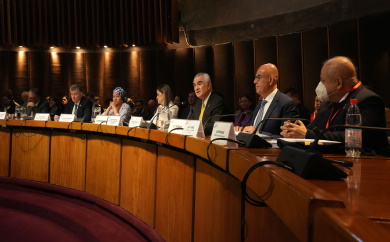
Addressing the seventh meeting of the Forum of the Countries of Latin America and the Caribbean on Sustainable Development that ends here on Thursday, the Deputy Secretary-General of the United Nations, Amina Mohammed, said “Latin America and the C
“But the SDGs were born in this region, and with clear focus, commitment and catalyzing action, the region can rise up stronger than ever and deliver on the vision of the SDGs,” she added.
She said at the SDG Summit last September, governments endorsed a bold Political Declaration, renewing the the world’s commitment to drive transformative change to deliver on the promise of the 2030 Agenda.
 “It also commits to advancing the Secretary-General’s proposal for an SDG Stimulus of $500 billion a year. It lays down a pathway for action on debt, so that resources are freed for investments in sustainable development.”
But Mohammed acknowledged that the Declaration was only the first step, saying it must be followed by concrete, ambitious and transformative action that will put countries on the path to deliver on their climate and SDG commitments by 2030 and beyond.
“In this regard, it is essential that we zero in on key transitions and investment pathways that can drive progress across the goals, including sustainable food systems, energy and climate action, education, digitalization, jobs and social protection.
“There are significant opportunities here across Latin America and the Caribbean. And in many of these areas, you are already demonstrating how a long-term vision can drive these transitions. ”
The UN Deputy Secretary General said digitalization can drive new economic opportunities, build resilience and reduce poverty, noting however that currently, too often, it reinforces inequalities.
“Broadband reaches less than twenty percent of people in Latin America and the Caribbean. A third of people do not use the internet at all. This region urgently needs investment in digital public infrastructure and the expansion of digital connectivity. “
She spoke of positive examples in Latin America and the Caribbean, including the creation of a Ministry of Digital Transformation in Trinidad and Tobago and Chile’s Integrated Platform of Electronic Services and Digital Talent program to Costa Rica’s National Telecommunications Development Plan.
“In all this, the UN development system is your trusted partner. We stand ready to help you strengthen institutions, governance and rebuild trust in democracy in a region that is seeing huge polarization. A conducive environment is essential to advance these complex transitions. “This will also require sophisticated expertise to shape policy and regulatory frameworks, harness investment, and secure support from multilateral and regional development banks, as well as private investments.”
She said the region was already coupling climate action with delivering a just and sustainable energy transition.
“While the region has achieved close to universal energy access, many disparities remain.
Up to 15 per cent of rural populations still lack electricity access. And two-thirds of the region’s energy supply still comes from fossil fuels.”
Mohammed said close to a third of energy supply comes from renewable sources, though we are witnessing rapid growth in solar and wind, as well as in green hydrogen development.
In 2020, financing for climate action in the region amounted to 0,5 per cent of regionalgross domestic product (GDP), far below the estimations that close to five per cent is required to reach regional commitments.
“With the right investments, we can achieve the SDGs and deliver an inclusive energy transition at the same time. In fact, these two go hand in hand. There is no dichotomy.”
Mohammed said the next round of Nationally Determined Contributions, or NDCs, which all governments must submit ahead of COP30 in Brazil, is a huge opportunity for countries to do just that.
“If done right, these plans can double as transition and investment plans – clearly defining national transition pathways and investment needs, and setting economy-wide, absolute emission reduction targets covering all greenhouse gases.”
She said with regards to addressing inequalities through food system transformation, tranforming the food systems is an effective way of tackling vulnerability and income disparities.
“Latin America and the Caribbean play a vital role in producing food that benefits not only the region but the entire planet. This region is the world’s largest net food exporter, and many economies rely on food exports. Yet, it has the highest cost of a healthy diet compared to all other regions.”
She said taking an integrated approach towards food systems transformation could enhance the performance of the agricultural sector and address structural income disparities.
On the issue of transforming education to secure a better future, Mohammed said as the world looks ahead to this year’s Transforming Education Summit Stock-take and related meetings, here are several critical areas for action.
“While most countries in this region have nearly achieved universal primary education, there is still some way to go on secondary and post-secondary education where progress has stalled.
“Now is also the time to seize the opportunities presented by digitalization and to ensure that teachers are supported, empowered and equipped for these and other major shifts.
As the world of work changes, it’s essential that education systems be geared to equip students with the values, skills and knowledge needed today.
“This includes basic digital literacy and the skills to thrive in a digital economy, from financial services to e-commerce. And with all of this comes the need for more not less investment in education. Public spending on education per student in the Latin America and the Caribbean region remains very low compared to more developed economies. Spending constraints, whether domestic or international, must be tackled.”
The executive secretary of the Economic Commission for Latin America and the Caribbean (ECLAC), José Manuel Salazar-Xirinachs, warned that just six years ahead of 2030, the target year for achieving the SDGs, “progress towards their fulfillment has not stayed apace with the implacable passage of the days in the calendar.
“On the contrary, we are seeing a strong misalignment in the indicators being monitored between the necessary trajectories for fulfillment and those currently observed. This demonstrates the urgency of picking up the pace,” he said.
ECLAC estimates that 22 per cent of the targets have been achieved or will be achieved by 2030, while 46 per cent of them are moving in the right direction but not at the speed needed to achieve them, and the remaining 32% are not expected to be fulfilled.
Salazar-Xirinachs said he trusts that over the duration of the conference there would be “dialogue, exchange of experiences, best practices and learning between all stakeholders, the motto of the upcoming Summit of the Future – ‘multilateral solutions for a better tomorrow’ – will spur us to revitalize our commitment to the 2030 Agenda”.
CMC./af.ir/2024