
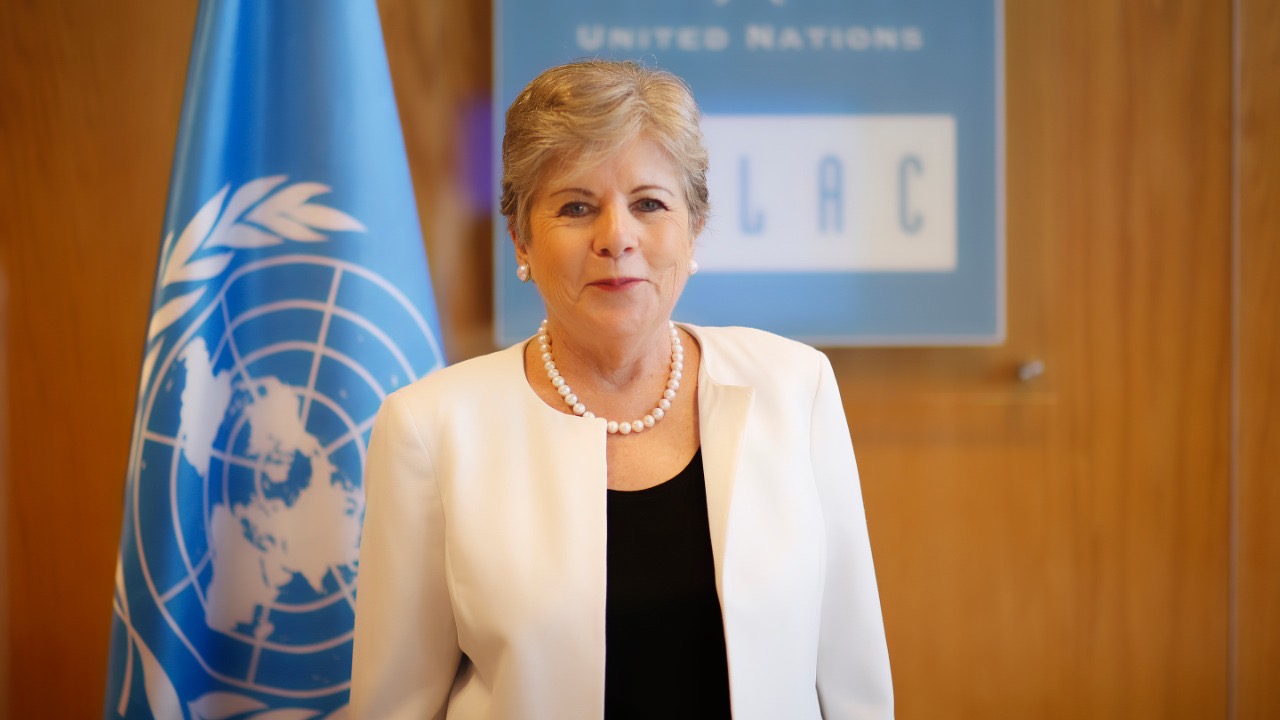
SANTIAGO, Jun. 6, CMC – The Economic Commission for Latin America and the Caribbean (ECLAC) is calling for urgent reconsideration of the criteria for measuring and classifying development while also suspending the “graduations” of middle-income countries, such as those in the Caribbean, during the COVID-19 pandemic.
Addressing the 20th session of the High-level Committee on South-South Cooperation, ECLAC’s Executive Secretary, Alicia Bárcena, noted that “the region of Latin America and the Caribbean is basically made up of middle-income countries that, in the context of financing for development, have been left out of access to concessional funds, especially Caribbean island-states and small, Central American economies.”
Bárcena was one of the panelists in the thematic discussion entitled “Accelerating the achievement of the SDGs (Sustainable Development Goals) through effective implementation of the BAPA+40 outcome document while responding to the COVID-19 pandemic and similar global crises”.
ECLAC said the High-level Committee on South-South Cooperation is a subsidiary body of the United Nations General Assembly that meets every two years to review progress and provide policy guidance that helps strengthen international support for such cooperation.
The session this year is the first that the committee has held since the Second High-level United Nations Conference on South-South Cooperation (BAPA+40), which took place in 2019 in Buenos Aires, Argentina, ECLAC said.
“We need to have an index of multidimensional vulnerability for middle-income countries,” Bárcena said. “‘Graduation’ from Official Development Assistance (ODA) cannot be tantamount to exclusion and winding up in limbo in terms of cooperation.
“This is about contributing to a different way of addressing international cooperation, among peers, more horizontally,” she added. “South-South cooperation teaches us important lessons in this sense.
“We are also seeking to be incorporated into initiatives, such as the debt service suspension initiative or to participate in a more multilateral committee on taxes worldwide,” continued Bárcena, stating that “ECLAC, the European Commission, the Development Center of the Organization for Economic Co-operation and Development (OECD), and other partners, have created the concept of ‘Development in Transition,’ which questions the use of per capita GDP (gross domestic product) as the sole criterion for graduating countries.
“We consider development to be a gradual process, not a linear one,” she said. “We should talk about gradations, not graduation, because these indicators should include countries’ capacity to save, access to capital markets, investment, and fiscal progressivity.”
According to Bárcena, “today more than ever, Latin America and the Caribbean has demonstrated its historic commitment to South-South and triangular cooperation, with innovative, solidarity-based criteria.”
She underscored that ECLAC has established a committee on South-South Cooperation since 1981, pointing out that Latin America and the Caribbean should strengthen its regional agreements and collaboration mechanisms, and build “a vigorous and concerted voice in the world.”
“More than ever before, we need regional initiatives to deepen the generation and exchange of capacities, knowledge, experiences and good practices, and to create common spaces for action to optimize the response to COVID-19,” Bárcena said. “Our region has a great deal to offer: we have a solid network of cooperation agencies that have given impetus to South-South and triangular cooperation initiatives.”
The ECLAC head said that Latin America and the Caribbean is the developing region of the world that has been most affected by COVID-19, with 8.4 percent of the global population and 30 percent of all deaths.
She said the region is also the most highly indebted region and has the largest external debt service, as a proportion of exports of goods and services (more than 54 percent).
Meanwhile, Bárcena said achievement of the SDGs has shown “marked heterogeneity” in the region.
She said only 32 percent of targets have been achieved to date or are on track to be achieved by 2030, if trends continue.
During her presentation, the executive secretary said that ECLAC’s proposal for a transformative recovery urges countries to eradicate poverty and move towards equality; build authentic competitiveness; promote environmental sustainability; revitalize the process of regional integration; and further the eLAC-Digital Agenda for Latin America and the Caribbean platform, among other measures.
Bárcena said that the COVID-19 crisis has revealed “the enormous asymmetries between developed and developing countries.
“Unequal access to vaccines is a sad example of how much progress is needed on cooperation to collectively achieve the provision of global public goods,” she said. “We call for rethinking development and cooperation, and for building a new social and political compact, with new coalitions and institutions.”
CMC/nk/kb/2021