
By Garvin Richards
KINGSTOWN, St. Vincent, Nov 25, CMC – A regional climatologist Wednesday warned that a strong El Niño event is expected to bring significantly drier conditions, increased heat and warmer ocean temperatures across parts of the Caribbean during the 2026/2027 dry season.
Climatologist at the Barbados-based Caribbean Institute for Meteorology and Hydrology (CIMH), Dr. Cédric J. Van Meerbeeck, said that the eastern and southern Caribbean are particularly vulnerable to below-normal rainfall and reduced water availability as the region experiences the effects of El Niño.
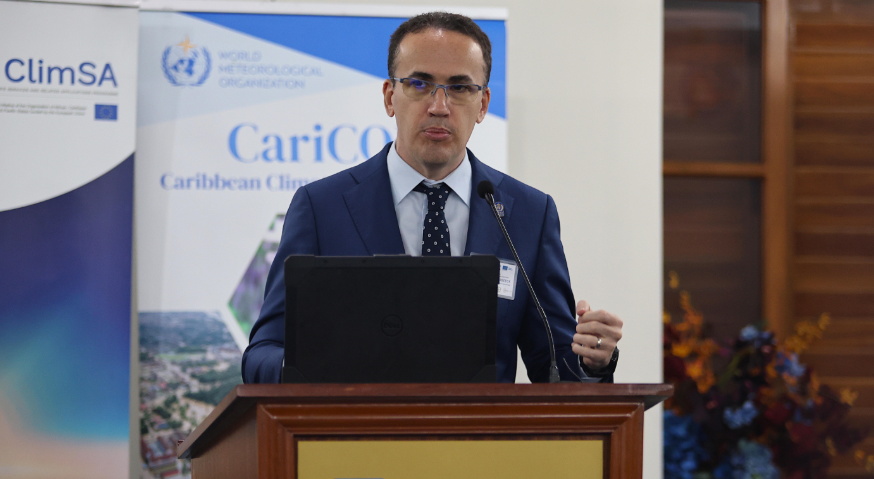
Addressing the 2026/2027 Dry Season Caribbean Climate Outlook Forum Stakeholder Forum here, Van Meerbeeck, who is also a senior lecturer in Climate Science at the University of the West Indies (UWI), said the developing El Niño event occurs when ocean temperatures in the equatorial Pacific become significantly warmer than normal.
“What that translates to for the Caribbean is a higher chance for drought, and especially in the eastern and the southern Caribbean,” he said, noting that the effects could extend beyond reduced rainfall, with the region also facing the prospect of exceptionally warm conditions.
“Besides driving drought, especially impactful drought at the end of the dry season, what we also see is that the year after the onset of an El Niño you get record warm or near-record warm conditions.”
Van Meerbeeck said that countries must prepare for both prolonged dryness and excessive heat, noting that “means we need to protect ourselves against dryness but also against excess heat”.
According to the climatologist, the El Niño-related dry conditions do not necessarily mean that the region will experience an absence of rainfall. Instead, rainfall events are likely to become less frequent, although some could be particularly intense.
“If we say drought, that does not mean that there’s not going to be any rainfall at all. It just means that the rainfall events will be fewer and farther in between, but they could still be impactful.”
He cautioned that intense rainfall episodes could trigger flooding, flash floods and landslides, potentially resulting in displaced communities and other cascading impacts, adding this is particularly important for volcanic islands, where heavy rainfall can have serious consequences.
The climatologist urged residents and national authorities not to become complacent simply because the broader seasonal outlook points to dry conditions.
“Now that we know it’s going to be dry most of the time, we might be tempted to not be worried too much about rainfall, but you still need to follow what the Met Services say in your country because they will be able to tell you when that rainfall does occur, because that will be impactful too.”
The CIMH climatologist called for national discussions on the sustainable allocation and management of water, noting that several sectors of society depend on the resource.
“We need to have national discussions on how to allocate water sustainably across the sectors of society because there are many sectors that require water as a very important resource.”
He also emphasised the need to protect vulnerable populations against excessive heat over the coming year.
Beyond drought and heat, Van Meerbeeck identified additional environmental and weather-related concerns associated with warmer ocean temperatures around the Caribbean.
He warned that increased ocean heat could contribute to coral reef bleaching and potentially an uptick in hurricane season activity.
“The extra heat in the ocean around the Caribbean next year means that there’s a chance for coral reef bleaching and there’s also a chance for uptick of hurricane season activity,” he stated.
The agricultural drought outlook presented at the forum further illustrates the varying levels of concern across the region. The CIMH map, projecting agricultural drought alert levels at the end of December 2026, identifies areas under drought watch, drought warning and drought emergency, while other territories remain in the no-concern category.
The projections highlight the potential implications for agriculture, water security and livelihoods across the Caribbean and Van Meerbeeck said the most important response at this stage is for people to remain alert and follow official weather information.
“Pay attention, stay updated,” he advised, encouraging the public to monitor updates from their respective national meteorological services, not only through seasonal climate outlooks but also through regular weather bulletins broadcast on radio and television and published in newspapers.
Emphasising the expected duration of the dry conditions, he said El Niño can influence rainfall patterns from the summer of its onset through the northern hemisphere winter, which extends to approximately February.
“That means that until the end of the northern hemisphere winter, which is about February, we have a higher chance, especially in the eastern Caribbean and the southern Caribbean, of having much drier than usual conditions, and that leads to a reduced availability of water,” he explained.
The 2026/2027 Dry Season Caribbean Climate Outlook Forum brings together climate experts, meteorologists, media practitioners and regional stakeholders to examine climate projections and strengthen climate risk communication.
With the region facing the prospect of a challenging dry season, the message from CIMH is clear: Caribbean countries must prepare for water shortages and extreme heat while remaining vigilant against the possibility of sudden, intense rainfall and its associated hazards.
CMC/gr/ir/2026