
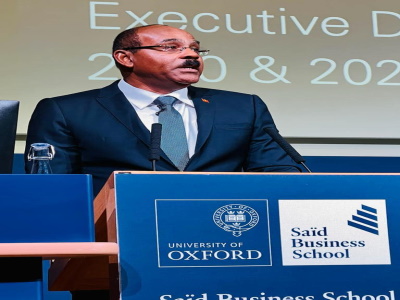
OXFORD, Jul 18, CMC -Antigua and Barbuda’s Prime Minister Gaston Browne, Tuesday warned that Generative Artificial Intelligence (AI) has potential implications for responsible leadership and could result in serious geo-political implications.
“In fact, it is projected that AI will be far more impactful than previous technological advancements,” Browne said, noting that AI is fast becoming a mainstream concept with the generative chat box, Chat GPT, that has taken the world by storm.
Delivering the feature address at the Convocation Ceremony of the Said Business School of the University of Oxford, Prime Minister Browne said that transformative leadership has revolutionized societies and the planet, resulting in the contemporary Fourth Industrial Revolution or Industry 4.0.
“The fourth Industrial Revolution has seen the advancement of information communication technologies (ICT’s), resulting in increased inter connectivity, smart automation and overall digitalization of our societies,” Browne said, adding “I am duty bound to remind you that these advances were not driven by leaders who maintain the status quo, but by transformational leaders”
He said digitalization, which is the use of digital technologies, has resulted in the transformation of business models to digital businesses, providing increased opportunity and new revenue and value -producing opportunities.
“Virtually all contemporary businesses comprise of some form of digitalization for increased productivity, and value-added digital services that could be monetized and delivered virtually without the need for physical premises,” he told the graduates of the graduates of the school that was founded in 1996, through the donations of businessman and philanthropist, Wafic Said. .
Browne said it is estimated that digitalization will be embedded in the fabric of virtually every job thereby, accounting for most of the new jobs created in the future; with careers in exciting areas to include: cyber secuirty, analytics, gaming, digital marketing, designing, social media management and political strategy.
The Antigua and Barbuda prime minister said the most exciting area of digitalization is still in its infancy and that AI’s unique characteristics utilizing the power of computer algorithms will impact literally all aspects of development, to include biotechnologies, nano technologies, politics and creative arts.
“There are however serious downside risks associated with the potential misuse of AI to generate misinformation and disinformation, which could challenge our traditional foundations of global peace and security,” Browne said, adding that “this will necessitate the need for a strong regulatory framework to proactively curb, or eliminate the use of this exciting technology for nefarious purposes”.
He said that the early adopters of AI in their planning and decision making processes will certainly benefit from increased competitive advantage and AI is likely to shift the balance of power between nations who develop and control the technology.
“Currently, AI is seen as a strategic priority, and tens of billons of dollars are being invested by private sector technology firms and nation states, especially the USA and China. It was reported in September 2017, that Vladimir Putin told a group of students that “whoever becomes the ruler of AI will Become the ruler of the world.”
“Today, I say to you…that countries, leaders, artisans, professionals who are early adopters of artificial intelligence will obtain competitive advantage over their competitors. Future sustained competitive advantage is unlikely to be achieved without the adoption and application of AI.”
Browne told the ceremony that while AI is not properly regulated at this time and comes with certain threats, the technology could be easily misused and could challenge the integrity of leaders.
He said this reinforces the need for responsible leadership with the integrity and self regulating standards to avoid misuse of the technology.
“A typical example is, AI could be used to generate misinformation and disinformation to achieve political influence at home and abroad. Also, it could give large technological companies that control its oligopolistic space, more power than nation states.”.
But Prime Minister Browne said despite these challenges, responsible leadership and regulations can ensure that AI is utilized as a force for good to take human civilization to the next level of progress and development; that is; industrialization 5.0.
He told the graduating students that innovation and creativity are crucial aspects of responsible leadership and are driven by vision, namely the ability to plan with wisdom and, or imagination for a sustainably better future.
“It’s the creativity, that is, the inventiveness and the new ideas, methods and products of innovation, that have resulted in the various industrial revolutions; transitioning the global economy from an agrarian one a couple hundred years ago, to a service dominated global economy today.”
Browne said that a desirable world is one with responsible leadership, that recognizes common humanity and that mankind will only flourish in conditions of peace, where markets are stable, where inequities are eliminated, and where business is transacted in a relationship of fairness.
“Unfortunately, that is not the world in which we now live. Russian aggression in Ukraine, in violation of the Charter of the United Nations and international law is the most obvious manifestation of the phenomena in the world, that prevent mankind from inhabiting our one homeland – the planet Earth – peacefully for the benefit of all its people, particularly the small and powerless.”
He said small states such as his, have no military might and no economic power.
“We can neither threaten economic sanctions, nor give financial support to advance our interests. Nor can we threaten or invade any other territory. For us, a rules-based world is imperative; and adherence to those rules by all is essential.
“The Russia-Ukraine conflict has harmed our economy and has raised the cost of living to our people, by creating a shortage of food products and driving up the costs of shipping and other logistics.”
But he acknowledged that “there are many other urgent problems,” noting that climate change, for example, “is one of them, and is the most significant existential threat facing our country.
“With its relentless impact on civilizations, ecological systems; climate change threatens Antigua and Barbuda and many small island states around the world. Currently, 10 nations are responsible for more than 90 per cent of the greenhouse gas emissions; this and the historical emissions of the G7 countries are largely responsible for climate change, global warming and sea level rise.
“And despite, year upon year of so called “global negotiations”, the world is now set to fail in the declared objective of holding global warming to 1.5 degrees Celsius over pre-industrial levels, which is the tipping point to disaster for many of us.”
Browne said that while the powerful may be hearing the pleas of the powerless, “they are certainly not listening, adding “responsible leadership also requires a listening ear, empathy and proactive action to avert crises”.
He said the most critical problems faced by countries such as Antigua and Barbuda are compensation for the repeated loss and damage, that they have suffered from repeated disasters caused by climate change and the need to build resilience to the impacts of climate change faster than they are occurring.
“We have incurred large debt on commercial terms, to repeatedly rebuild after disasters, and to build resiliently to resist the destruction caused by others,” Browne said, adding “the UN process of an annual meeting of the Committee of the Parties (COP) has promised much and delivered little.
“Consequently, we have had to take on leadership roles in the international community, to protect ourselves from the disinterest in our plight displayed by the world’s worst greenhouse gas emitters.”
He said Antigua and Barbuda together with Tuvalu, founded the Commission of Small Island States on Climate Change and International Law (COSIS) two years ago, in Glasgow in the margins of COP26.
Browne said the purpose of COSIS is to seek first an Advisory Opinion from the International Tribunal of the Law of the Sea (ITLOS), on the obligations of all states not to cause ecological and environmental damage to other states and their responsibility to compensate for losses flowing from their actions.
“ITLOS has scheduled a hearing for our case in September in Hamburg. We are hopeful for a helpful opinion; that will support the principle that the polluter pays.
“Hopefully, the threat of litigation will force more responsible leadership, in curbing the profligate use of fossil fuels to save our planet from the catastrophic consequences of climate change,” Browne said, warning also that the world is witnessing a retreat from multilateralism which will adversely affect global business.
He said protectionist barriers to trade are reemerging, ideologies are resurfacing, and divisions between the global north and the global south are becoming more pronounced.
“None of this contributes to the enhancement of a world community where peace prevails, trade prospers, and economic development is achieved with equity and fairness. The world, if anything, consists of rivalry, unfair competition, inequity, and the might of power,” the Antigua and Barbuda Prime Minister told the graduate students.
CMC/ag/ir/2023