
BELMOPAN, Belize, Sept 14, CMC – The Belize government Monday registered its “strongest protest” over an incident that occurred last Thursday in which a significant deployment of Guatemalan military and civilian vessels obstructed a group of Belizean nationals from completing their customary passage around Sarstoon Island.
The Ministry of Foreign Affairs said that a bilateral meeting will also be sought between Prime Minister John Briceño and President Bernardo Arévalo next week on the margins of the United Nations General Assembly as a result of the situation.
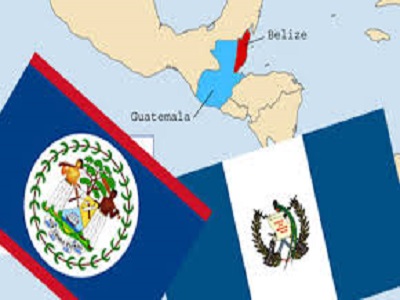 According to the Ministry of Foreign Affairs the Belize Territorial Volunteers (BTV), escorted by the Belize Defence Force (BDF) and the Belize Coast Guard, departed Punta Gorda for their annual journey to circle Sarstoon Island, a passage the group has undertaken for nearly two decades.
It said approximately 18 Guatemalan vessels, comprising both military and civilian craft, were present in Belizean waters within the immediate vicinity of the island.
“The Foreign Ministry wishes to be unequivocal: the Sarstoon River constitutes part of the international boundary between Belize and Guatemala, as established under the 1859 Boundary Treaty between Great Britain and Guatemala, with the boundary line running along the mid-channel of the river.
“Sarstoon Island lies within Belizean sovereign territory, and the treaty guarantees that the channels of the river remain equally free and open to the vessels of both countries.”
The government said that Guatemala’s deployment of a “disproportionate flotilla in Belizean waters in violation of Belize’s sovereignty and to obstruct the lawful passage of unarmed Belizean nationals is inconsistent with these obligations.
“Furthermore, the presence of Guatemalan civilians within the military deployment represents an unwelcome escalation in an already sensitive border area.”
The Ministry of Foreign Affairs said that it has since dispatched a Note Verbale to the Ministry of External Affairs of Guatemala “protesting in the strongest terms the aforementioned incident of September 10, 2026.
“The Ministry is also formally notifying Belize’s international partners and friends, as well as the Organization of American States (OAS), of this incident and its implications for regional stability.
“Furthermore, the Ministry will seek an explanation of the aggressive behaviour of the Guatemalan military from the Ambassador of Guatemala to Belize,” it said, reaffirming “its full confidence in the International Court of Justice process as the appropriate mechanism for the final resolution of Guatemala’s territorial, insular, and maritime claim”.
Belmopan is also calling on the government of Guatemala to refrain from actions on the ground that prejudge the outcome of that process or place civilians and security personnel at unnecessary risk.
“The Ministry has instructed the Office of the Agent to consult Belize’s international legal team to ensure that these acts are appropriately referred to at the hearings before the Court and that the Court is apprised of these and any acts of a similar nature.”
The Belize government said that it also wanted to commend the professionalism and restraint exercised by members of the BDF and the Belize Coast Guard “in managing this encounter and reassures the Belizean public that it will continue to take all necessary and appropriate diplomatic measures to safeguard Belize’s sovereignty and territorial integrity”.
Last week, the OAS Secretary General Albert Ramdin said he was “not completely surprised” at the latest flareup between Belize and Guatemala even as he had “hoped that these things would not happen”.
Ramdin said the incident “confirms something which we had already indicated that I do expect in the coming months, given the sensitivities, Independence Day and all of that, that some groups will create some incidents,” he said, adding “so I’m not completely surprised. I had hoped that these things would not happen”.
Belize and Guatemala have a long-standing territorial dispute with Guatemala claiming more than 11,000 square kilometers of Belizean land, islands and maritime areas. The dispute is before the ICJ.
In March 2000, Belize and Guatemala resumed discussions on their territorial dispute with the assistance of the OAS and on November 8, 2000, they signed the first Agreement on Confidence Building Measures, establishing an “Adjacency Line” and a one-kilometer “Adjacency Zone” on either side.
A second Agreement was signed on February 7, 2003, and subsequently amended in September 2005 by the “Agreement on a Framework for Negotiation and Confidence Building Measures between Belize and Guatemala.
On September 1, the foreign ministers of Belize and Guatemala Tuesday met with at Ramdin at the the Adjacency Zone, a territorial strip 213 kilometers long and two kilometers wide and was established in 2000 as a key confidence-building measure to preserve stability, dialogue, and peace during the process to resolve the territorial dispute between the two countries.
CMC/fh/ir/2026