
BRIDGETOWN, Barbados, Aug 18, CMC – The Barbados government says it will make immediate amendments to the controversial exception clause in the Interception Of Communications Bill, 2025.
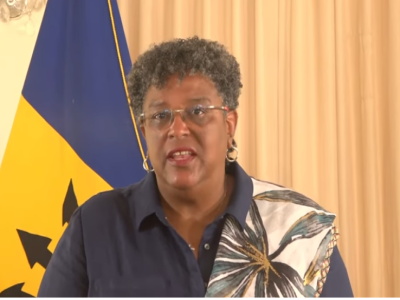
Prime Minister Mia Mottley in a radio and television broadcast on Sunday night the exception clause in the legislation which was passed in the House of Assembly last week, will not be proclaimed.
“The Bill which was passed in the House of Assembly last week carried an exception clause, a root by which an interception could be treated as lawful without a judge’s warrant in specified circumstances.
“But after a thorough weekend review and after advice from the Attorney General (Dale Marshall) with input from the relevant authorities and stakeholders and being mindful of public concern, we are satisfied that this exception ought not to be proclaimed, and in fact should be repealed” Mottley said in the broadcast.
“We will therefore act accordingly by removing this clause in the Senate and sending the same back to the house of Assembly for concurrence. My friends, this government has the humility to listen and always the courage to correct,” she added.
Mottley said that the government will keep refining the law where necessary “ so that it makes sense to the people it is required to protect.”
Prior to her broadcast, the government had issued a statement in which it said that the government had heard concerns of Barbadians on the legislation and that the broadcast “will spell out exactly what led to the decision to change the clause in the bill as well as how it intends to execute the adjustment to make it possible for “interceptions only by judge’s warrant”.
The statement said that she would also be speaking “candidly with Barbadians about a number of other pieces of legislation that were discussed and ratified” during recent sittings of the Parliament, including the Criminal Proceedings (Witness Anonymity) Bill to offer greater protection to witnesses in criminal proceedings, and the Juries Bill that will significantly enlarge the pool of citizens from which jurors can be selected and the Firearms (Amendment) Act.
Mottley told the nation that she had read the commission on crime report by the main opposition Democratic Labour Party (DLP) give that she has “always said that good ideas must contend and on citizenship, security, we are not partisan.
“Many of the proposals that the opposition have made are already in train. There is, however, one idea that stood out for me, which I want to just reinforce, because I believe that it requires serious consideration, and it is in the next step to what we would like to do next year, which is the notion of a unified family court”
She said that family court is also a manifesto commitment of the ruing Barbados Labor Party (BLP), bringing under one roof the services that protect children, families and the most vulnerable, with strong mediation and with social support.
“We are prepared to widen the national conversation on a few other of their initiatives as well,” she said, adding that she would be inviting the Opposition Leader, Ralph Thorne as well as the chair of the DLP’s commission on crime, Verla De Peiza, to meet with the Advisory Council on citizen security “and to see what other aspects of it we can come to a unified position on.
“It matters not to me, what route we get there, only that we have a unified country fighting the awful, awful spec of crime. I want to recognize Ms De Peiza who led the commission’s work, and I congratulate her and all of the members for the time and effort invested in this important matter.
“ I do not take these things lightly. My hope is that the opposition leader therefore will see the sincerity in the request and to recognize that this government will not treat this space as a space for petty partisanship, but a place for all hands and all good ideas to contend. We can differ on many other things, but our country requires us to act in harmony on this matter,” Mottley said.
But she noted also that some of the people who shout that something should be done about crime are among those who when laws are being implemented raise objections.
“At some point Barbados, leadership must mean this. We will listen, we will consult, we will refine, but we will not be paralyzed by the impossible task of pleasing everyone. The rights of the many to live safe, decent lives cannot be held hostage by the few who would prey upon them, and we will lead my friends, trust me, as we did before, through difficult moments.”
Mottley said that regarding the criminal proceedings witness anonymity bill, too many cases regrettably collapse because good people are afraid and with reason.
“This law gives the court, not the government, the tools to protect identity when it is necessary and only if it remains fair to the accused. That means judges can order screens, voice modulation, redaction of identifying details, and indeed special directions to juries to guard against any prejudice to the accused,” she added.
Mottley said that the jury’s Bill modernizes how persons are called to be jurors.
“Outdated property and income barriers belong to another era. Jury service, my friends, should look like Barbados across our communities, across ages and across income levels. And if we ask you to serve, we must make it possible for you to do so without hardship.
”When juries are representative, verdicts carry the weight and legitimacy that justice demands. We must allow the jury system to work efficiently. We are therefore allowing for the joinder of indictments, so that we would no longer have to do multiple trials involving differently constituted juries when a single jury trial would suffice.”
Mottley said for example, if a man is charged with murder and rape and burglary, all at the same time, “we now have to hold separate trials because a murder jury is 12 and the other juries are nine. Let us remove that artificial barrier and save time, save money and be fair to all”.
She said Barbadians, in fact, want something to be done about crime, about organized networks, about illegal guns, about the brazen planning that hides behind screens and encrypted devices.
“We listened to the police who continue to do an excellent job, as recent as yesterday, even in picking back up those who have eluded custody. We studied the best practices in our region and internationally, and we brought a law that allows targeted judge issued warrants to intercept communications only for the most serious offenses and matters of national security.
“Let me be crystal clear, this is not a free for all, and this is not a minister’s toy. No politician can grant a warrant, only the Chief Justice or a judge specifically assigned by him can authorize an interception. The warrant is time bound. Irrelevant material gathered must be destroyed. There is an independent monitoring mechanism appointed by the President of Barbados to oversee how the power is used.”
Mottley said that the firearms Amendment Bill tightens the law around illegal guns and components.
“My friend, this is about closing loopholes supporting enforcement and making sure that those who take people’s lives face the full force of the law. A safer Barbados is not built by marching up and down every weekend. It is built by clear statutes capable policing and strong courts working together,
“We have to go back and do a slight amendment to that firearms amendment bill, because we recognize that there may well be too broad a definition of components, and we need to qualify it by putting the word major before it, so that persons are not inadvertently caught in the loop by dealing with components of firearms,” Mottley told the nation.
CMC/jg/ir/2025.