
BRIDGETOWN, Barbados, Jun 13, CMC – The Barbados government says it will soon introduce legislation that will allow for the wireless surveillance as admissible evidence in court.
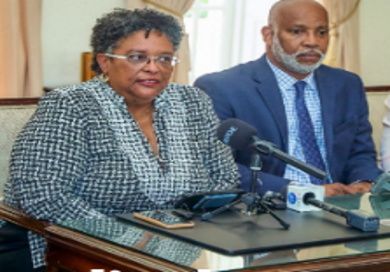
Prime Minister Mia Mottley said that the legislation will also allow for lie detector tests for individuals with access to sensitive areas and that a draft of the proposed wireless intercept law had been reviewed by a subcommittee of the Advisory Council on Citizenship Security, chaired by legal scholar Professor Velma Newton.
“We would have spoken previously to you that a consultative process on wireless intercept legislation and being able to use the intercepts as evidence in a law court is something that we would wish to pursue. The subcommittee that has reviewed the legislation, has finished their work.”
Mottley told reporters that it now has to go to the full council and that the Cabinet and the Parliament will take the necessary steps to introduce that legislation “conscious that in many instances intel is available, but if you can’t use that intel as evidence, there is then a break between what you can carry to court and what you know.
“The government has determined that we cannot continue to have that situation obtain, and therefore we want to bridge the gap with the passage of the legislation. Once we get it back from that advisory council, that will move with dispatch.”
Mottley also indicated that the authorities here are also preparing to introduce “truth verification” or polygraph testing to strengthen national security protocols.
“The truth verification testing is not focusing on any category of worker; it’s focusing on persons who have access to certain secure spaces. If you have access to certain secure spaces, then we need to ensure that you are acting with the integrity that we need you to act with such that the rest of the society is not put at risk,” Mottley said.
She said that the truth verification testing, therefore,”is a fancy set of words, effectively a lie detector test, and therefore it will be subjecting both public and private sector persons.
“We accept that persons cannot be forced in certain circumstances to do it and therefore if they can’t work they won’t have access to those areas and may have to be placed in other jobs, but the AG will continue those discussions and set a timeline.”
Mottley said to support the implementation of this initiative, the government has spent the past year building capacity, training personnel, and acquiring the necessary equipment.
“We are at a stage now ready to execute and I expect therefore that the AG will be meeting with the unions in the next week, ten days, to be able to set the timelines for that to become live,” she said.
CMC/gf/ir/2025