
By Peter Richards
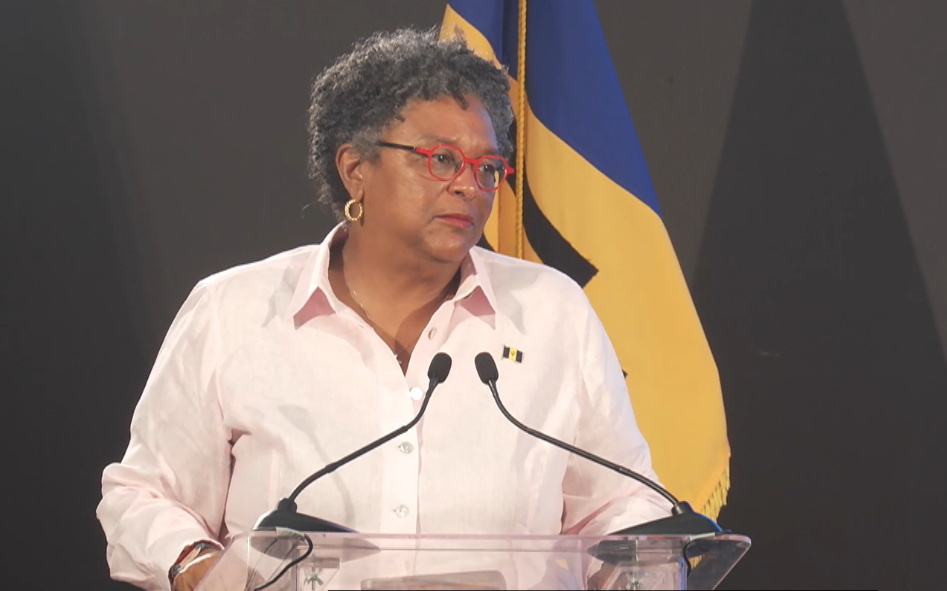
BRIDGETOWN, Barbados, Nov 23, CMC – Barbados Prime Minister Mia Mottley Monday told the global community that if the international rules-based order continues to be undermined and might trumps all other things then developing countries like hers would find it difficult to leave a legacy for their future generations.
Addressing the inaugural Bridgetown Special Summit on Artificial Intelligence (AI) Safety, co-hosted by the her government and the United Nations, Mottley said that the event provides an opportunity for small states to be able “to have our voice first because small states often do not have the opportunity to share perspective in the rules that affect them.
“We have complained too often that one-size-fits-all prescriptions hamper us in our development and that is why our government took the clear decision to be able to work with the United Nations to ensure that we could host this summit and particularly to focus on safety and inclusion for AI.”
She told the global audience attending the hybrid and in person event that “without that, we have no hope or chance.
“I have said to my people that we face a number of existential crises as a nation. One, obviously, the climate crisis and the loss of biodiversity. And we all know what happened yesterday in Antalya, (COP31) and rather than see it as a defeat, we see it as a movement to make us work even harder for the next occasion”.
Mottley said Barbados will celebrate in the next week its 60th anniversary as an independent nation and its fifth anniversary as the world’s newest republic, believing that “those things that we have fought to attain this status were important.
“And we would want to ensure that 60 years from now, our children are still enjoying the right to be firm craftsmen of their faith and to defend their trajectory and where they want to go. Regrettably, if the international rules-based order continues to be undermined and might trumps all other things, then that will not be the legacy that we can leave for them.”
Mottley said that Barbados and small island developing states have been told in the past that “all that glitters is not gold” and “very often, something that is sweet ends up having the worst impact for you.
“The allure of greater efficiency, greater capacity, is something that all of us want, as small states, as middle powers, as large countries. But that allure left to its own devices and that capacity without guardrails can in fact be the bane of our existence.
“And we have, therefore, to ensure that as we work here, we can find a way of ensuring that the divisions between wealth and poverty, between states that have a lot and those that don’t, are bridged. Because if not, we will end up with a feudal overlordship again that we’ve only read about in our history books.”
She said that she is hoping that coming out of this summit “we will find ways of being able to bridge that gap” noting “we already start with low levels of literacy, lower levels of literacy among lower income states, and therefore we do not start from the same ground.
“We already start with great disparities in computing power. I hope, therefore, that as we move forward, we will find a way to bridge this awful divide that can only get worse,” she said reiterating a warning that global inequality is leading to the rise of fascism and populism.
“It is leading to disparities within countries. It is leading to a lack of social cohesion. So that these are the things, this is the context against which we meet today and against which we will make decisions,” she added.
French President Emmanuel Marcon said while there has been an acceleration of AI tremendous opportunities in the field of science, medical research, education and so on, states nonetheless need to “push forward such developments” and that France intends to take a big part in this race.
“In parallel, we have also seen fast-growing concerns in regards to the risks caused by this technology,” he said, making reference to at least four categories of risks, namely the risk of interference with nuclear fibre bio and chemical risks, the risk of loss of control, especially of frontier models, as well as the risk of an increasing concentration in the hands of a very few players and that the risk for children and democracies.
“As we develop the technology, it’s our responsibility to protect our people. This requires an ability to assess the threats and make for our own decision,” he said, noting that following Finland and Norway’s initiative and the dialogue that followed, Paris convened a meeting with heads of states and governments and major AI players earlier this month with the outcome being the signing of he Paris call for AI security, which he described as “the first joint declaration between companies, safety institutes, and governments on AI security”.
Marcon said that the declaration highlights the main outcomes the participants at the conference agreed to work on including the need for independent evaluations, the need to align on common standards, including for incident reporting as well as the need to reaffirm the AI lab’s accountability.
“As a consequence, we believe agreement to such principles should condition the access or not to our markets and our people. This declaration was signed by 18 heads of state and government, as well as 11 AI leaders…as well as 11 civil society organisations.
“Clearly, we need to keep this momentum. So today, my message to you is very simple. The Paris call is up for you to join. We will keep expanding the scope of signatories, and we will keep involving all countries in this process.
“And we need to put in place the independent evaluations and incident reporting system. We need these independent auditing teams. The work ahead of us is a complex task, one that can only be worked on together. Governments, experts, and companies, thus paving the way for a global governance on AI security for all of us,” Marcon said.
Norwegian Minister of Digitalisation and Public Governance, Torgeir Micaelsen, reminded the audience that “we have all heard the warnings, AI is advancing rapidly.
“Our ability to understand, govern and control, it is not keeping pace. Frontier AI may be developed by a few, but its consequences will be shared by many. When risks cross borders, so must our cooperation.
“None of us can meet this challenge alone. Together we can. We need to know what these systems can do, where the risks are and when we need to act. Those developing the most powerful systems carry a particular responsibility. But so do governments,” Micaelsen said, adding that “keeping powerful AI safe requires both”.
He said that just as the risks of AI should not be borne by the many, its opportunities should not belong to the few.
“Access means more than having the technology. It means having the knowledge and capacity to shape your own AI future. This is also why Finland and Norway launched the call for control of frontier AI models.
“We believe countries need to come together, not only to understand these risks, but to be able to act on them. I encourage all countries that have not yet done so to join the call for control of frontier AI models,” Micaelsen said, noting that the United Nations has a unique role in bringing countries together and ensuring a genuinely global conversation on AI governance.
Commonwealth Secretary General, Shirley Botchwey said the Bridgetown Special Summit on Artificial Intelligence (AI) Safety has made the Barbadian capital a byword for imaginative solutions to pressing global challenges.
“Today you are bringing the same clarity of thought to the crucial question of artificial intelligence. We should not underestimate the enormous potential of AI to transform lives for the better. But when a few companies in a handful of countries define the frontiers of that potential, the rest of us must live with systems we did not design and their consequences. “
She said that exposure without agency is a risk this summit seeks to address and that at the Commonwealth Heads of Government Conference (CHOGM) in Antigua and Barbuda earlier this month, the leaders endorsed an AI future “that is ethical, inclusive, safe, trustworthy and human centric.
“They called for greater capacity building, fairer access to data and talent and dedicated financing so that developing countries, including small island states like Barbados, can participate meaningfully in the global AI architecture.”
Botchwey said that AI must be governed by rules that every state has had an opportunity to shape.
“Those rules must be proportionate to risk and workable for every country, including the smallest. Governments need the capacity to deploy AI safely and to shape how systems are used in their national context. And we must work together to protect against potential risks.
“Because no nation can keep track of every threat alone and none should have to,” she said, noting that this is where the Commonwealth can help.
“According to Stanford’s global AI vibrancy ranking, four of the 10 leading AI nations are Commonwealth members. So are 33 of the world’s smallest states. As we encompass both sides of the AI divide, we are in a strong position to help close it,” Botchwey said, adding that in ay next year, alongside the United Nations global dialogue on AI governance, the Commonwealth will convene a high level event on AI.
“It will highlight how AI can empower small states from weather forecasting to carbon offsetting and it will draw on expertise from across our membership, large and small, to help avert new divides. We are committed to helping build the capacity of our members to contribute to the global dialogue,” she added.
Meanwhile, Microsoft has warned that while there is need for legal and other controls that are needed to keep the public safe, there is yet another contradiction.
“In other ways, we need things to speed up, not just AI safety, but AI diffusion, especially in the Global South. With each quarter and with each year, we still remain on a path where diffusion in the Global North is moving forward far more rapidly than in the Global South.
“One thing is clear. The United Nations has a critical role to play. That’s why your meeting is so important. We need international collaboration of a variety of forms, including the kind of universal collaboration that only the United Nations can bring,” the Microsoft representative told the summit.
Monday’s event has brought together stakeholders from governments, tech, science, civil society, and the UN under the core themes that focus on global AI safety cooperation, risk management, equitable access, capacity building, and cultural/linguistic representation.
The UN said that the summit serves as a collaborative platform without establishing binding global rules, enforcing a single governance framework, superseding national policies, or dictating the scientific agenda of the Independent International Scientific Panel on AI.
CMC/pr/ir/2026