
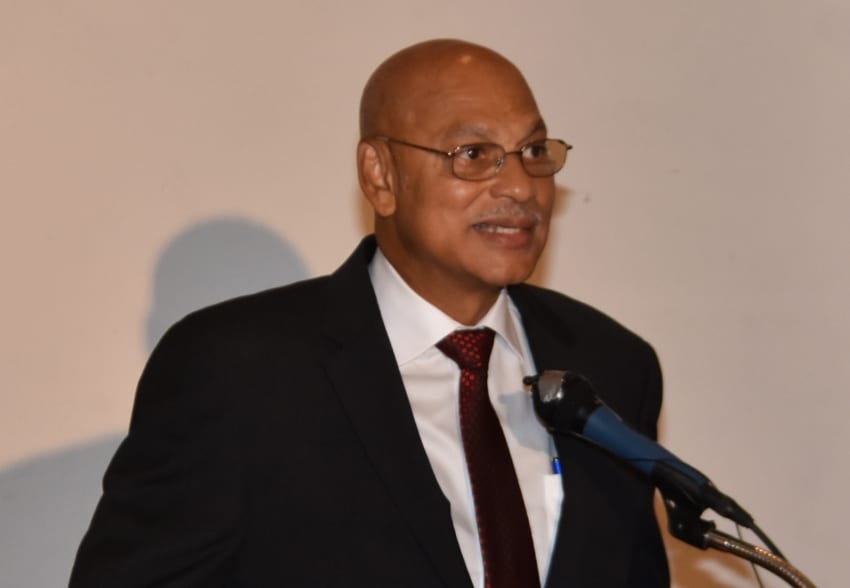
BRIDGETOWN, Barbados, Sep. 2, CMC – Minister of International Business and Industry Ronald Toppin has expressed concern about the two-pillar package on taxation in the digital economy being implemented by the Organisation for Economic Co-operation and Development (OECD).
And he disclosed that Government has established a Global Product Development Task Force comprising “a dedicated team” of public and private sector representatives to focus exclusively on addressing concerns.
Minister Toppin said that Pillar Two of the package, which seeks to put a floor on tax competition of corporate income tax by introducing a global minimum corporate tax, will have an impact on the island’s economy.
“The two-pillar approach of the OECD on taxation in the digital economy, as we know it, carries significant consequences and effects which must be weighed,” he said during the opening of a Product Development Workshop, hosted by Invest Barbados and the Global Product Development Task Force.
“From Barbados’ perspective, we are not overly concerned about Pillar One, rather, our concern lies with Pillar Two, which seeks to stop what is termed the race to the bottom, as it relates to global corporate tax, by implementing a floor of 15 per cent. What Barbados is concerned about naturally, is the impact that this can have on our economy.”
Barbados’ corporate tax rate is currently set at a maximum of 5.5 per cent of profits for all companies.
The Minister noted that an OECD report, dated July 1, 2021, stated: “130 countries and jurisdictions, out of the 139 members of the inclusive framework, had joined the statement establishing the new two-pillar plan aimed at reforming international taxation rules, and ensuring that multinational enterprises pay a fair share of tax wherever they operate”.
He further pointed out that an “ambitious” timeline for the conclusion of negotiations had been given, which includes an October 2021 deadline for finalising technical work on the Pillar Two approach, as well as a plan for effective implementation in 2023.
Emphasising that Barbados was not included in the 130 countries, the International Business Minister said careful consideration was given to an invitation to join the consensus statement.
“Government considered it strategic for our country to join to ensure that we are not pretty much alone on the outside, but rather sit at the table and continue to partner with other countries to work out the fine details, so that we have a system that is as fair and equitable as possible, to all. For example, Barbados is concerned about the time frame given for implementation, in light of our present circumstances in which we are grappling with an economic restructuring programme, and the ravages of COVID-19.
“We are also concerned about ensuring that there is an adequate economic substance carved out by way of the development of the appropriate formula. We know that negative listings are a cost to the country, and therefore, we must mitigate Barbados’ exposure to being negatively listed, or being seen as not cooperating with G20 and OECD, in addressing their concerns,” Minister Toppin said.
CMC/ed/2021