
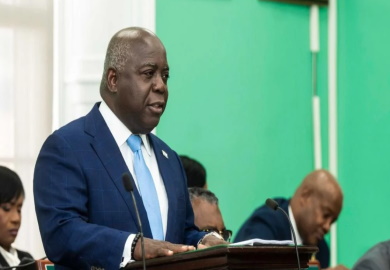
NASSAU, Bahamas, Oct 14, CMC – Prime Minister Philip Davis says the Anti-Terrorism (Amendment) Bill, closes a gap between what The Bahamas has committed to internationally and what the domestic law is able to deliver.
Davis told legislators that the international order that small states rely on is under real strain and that major powers are more willing to act alone.
He said that trade, finance and technology are increasingly used as instruments of pressure and that institutions that once seemed permanent are being tested.
“For a country like ours, the strategic conclusion is clear. We cannot shape the choices of great powers. We can make sure that the rules that still hold are upheld consistently, and above all, by those who depend on them most.”
Prime Minister Davis said that The Bahamas joined the United Nations in September 1973, weeks after independence and in accepting the Charter, Nassau accepted Article 25, under which member states agree to carry out the decisions of the Security Council.
He said Article 41 allows the Council to impose measures short of armed force, including the interruption of economic and financial relations.
Prime Minister Davis said that targeted financial sanctions are such measures, adopted under Chapter VII, they bind every member state equally.
But he said “there is a practical dimension to this.
“Our legal system is dualist. A Council decision has no force in our courts until Parliament gives it effect. The credibility of our commitment is therefore only as strong as the legislation behind it.”
Prime Minister Davis said that UN Security Council Resolution 1737, adopted unanimously in December 2006, requires all states to freeze the funds, financial assets and economic resources of persons and entities designated in connection with nuclear and ballistic missile programmes of proliferation concern.
He said it requires states to ensure that no funds are made available to them. It established a sanctions committee to maintain the list, with procedures permitting the release of frozen funds for basic expenses such as food, rent and legal fees, following notification to that committee.
He sad resolution 2231, adopted in July 2015, replaced much of that framework, maintained its own list of individuals and entities subject to asset freezes, and included a mechanism for reapplying the earlier measures.
“That mechanism was used in September 2025, and the measures first imposed under resolution 1737 were restored. Our law must capture designations under both resolutions and be able to follow the regime as it evolves,” Prime Minister Davis said, adding that “the architecture of our sanctions regime under the Anti-Terrorism Act, 2018 rests on a single definition that of a “designated person or entity”.
Prime Minister Davis said the obligations flow from it and that funds and assets held for a designated person must be frozen without delay and without prior notice.
“No person in The Bahamas may make funds, assets or financial services available to them, directly or indirectly. Holdings and attempted transactions must be reported to the competent authorities, and breaches carry criminal liability. ”
Davis said that those obligations extend to every individual and business in The Bahamas, not only to licensed banks, acknowledging that he recognises that some legislators will ask whether this cedes too much to the Council.
“It does not. Parliament sets the policy, and it does so in this Bill: The Bahamas will freeze the assets of those the Council designates in this field. The Council identifies the targets. That division of labour is an operational necessity.
“The Financial Action Task Force defines “without delay” as, ideally, within hours. A regime that required new legislation for each designation would fail that standard by months,” Prime Minister Davis said, noting that “retrospective provisions deserve scrutiny, and this one withstands it.
“It creates no offence for past conduct. It provides legal certainty for freezing and reporting actions taken in good faith by our authorities and institutions since that date. Sound regulation should never penalise those who complied early.”
Prime Minister Davis said that the first purpose of the Bill is straightforward insisting that The Bahamas is fulfilling its international obligations and commitments.
He said as a member of the Caribbean Financial Action Task Force, The Bahamas will be assessed saying that “we know the cost of such findings.
“After The Bahamas was grey-listed in 2018, correspondent banks reassessed their exposure, compliance costs rose across the sector, and those costs were ultimately borne by Bahamian households and businesses,” Prime Minister Davis said, adding that it took sustained effort across administrations to secure the country’s removal in December 2020.
“Financial services remain one of the two pillars of our economy. Protecting the credibility of the sector protects the jobs and incomes that depend on it. The second purpose responds to a changed environment. There is no doubt that we are living in an era of new threats and evolved threats.
“We should be clear-eyed about what has changed. Proliferation financing is structurally different from terrorist financing. Transactions are often commercial in appearance. Values vary widely. “
Prime Minister Davis said that the objective is procurement of materials and technology over time.
“Networks operate through front companies with ownership layered across multiple jurisdictions. Dual-use components are acquired in fragments and assembled elsewhere. National authorities and United Nations experts have documented state-linked actors stealing digital assets on a very large scale to finance weapons programmes.”
He said that the maritime dimension has evolved in parallel and that vessels disable their automatic identification systems, change names and flags in rapid succession, register with fraudulent documentation and transfer cargo between ships at sea, beyond the reach of port inspection.
“That has direct implications for The Bahamas. We operate one of the largest ship registries in the world. We regulate digital asset businesses under the DARE Act, 2024. Our international financial centre supports trust companies, investment funds and corporate service providers with clients worldwide.
“These are national strengths, built over decades. Their resilience depends on our law keeping pace with the Council’s designations, so that no part of our system is available to those seeking to evade them.”
Prime Minister Davis said the legislation delivers that alignment and that every designation the Council makes in this field will carry immediate legal effect here.
He said The Bahamas Maritime Authority, the Securities Commission, the Central Bank, the Financial Intelligence Unit and every reporting institution will work from one clear and current definition.
CMC/gk/ir/2026