
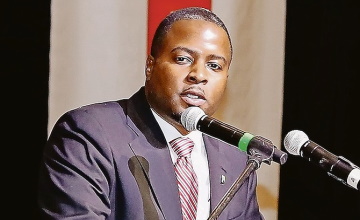
NASSAU, Bahamas, May 16, CMC -The lawyer representing opposition legislator and former executive chairman of the Water and Sewerage Corporation (WSC), Adrian Gibson, says he will appeal the ruling of a High Court judge who dismissed a constitutional motion on Monday.
Justice Cheryl Grant-Thompson dismissed Gibson’s application to stay his corruption trial ruling that his constitutional rights have not been infringed and that he can have a fair trial even if the Crown’s key witness gives testimony virtually.
The judge indicated that she would move to empanel the jury on Thursday to hear the case against the legislator, but his lawyer, Murrio Ducille, KC, objected, saying he would be appealing the ruling.
The attorney also said he would request a stay of proceedings until the Court of Appeal hears the matter.
Gibson along with former WSC general manager, Elwood Donaldson, Jr, Rashae Gibson, Gibson’s cousin, Joan Knowles, Peaches Farquharson and Jerome Missick, face a combined total of 98 charges, including conspiracy to commit bribery, bribery, fraud, receiving and money laundering.
They have denied the allegations.
In June 2022, Gibson, the member of Parliament for Long Island, was charged with 96 counts that stemmed from alleged misconduct while he served as the WSC executive chairman.
Prosecutors allege that Gibson illegally received more than US$1.25 million from contracts awarded by the corporation during his tenure as chairman.
On Monday, the judge had to rule on whether or not Gibson’s constitutional right to a fair trial has been breached by an alleged failure by the prosecution to provide “full disclosure”.
In addition, the High Court is to decide whether Gibson’s former fiancée, Alexandria Mackey, who has been granted immunity from prosecution in exchange for her testimony, will do so remotely or in person.
But the judge dismissed the application saying it was “misconceived and premature,” adding that the “application borders dangerously close to an abuse of the court’s process”.
During Monday’s court hearing, the Acting Director of Public Prosecutions Cordell Frazier said she had arranged to have Mrs Mackey testify in person if needed.
Mrs Mackey, who no longer lives in The Bahamas, also said it would cause her “hardship” to return to the country because her application for permanent residency in the United States is pending.
In her ruling, Justice Grant-Thompson said there was no reason virtual testimony could not be allowed once the necessary facilities and resources were available.
“The applicant never filed an affidavit in opposition of the video link application. Rather, the applicant invoked the constitution. Constitutional relief is a remedy of last resort. It should only be invoked where there is no other adequate remedy available.
“Notwithstanding that in the instant case, the applicant proceeded with an oral response to the application for live video link. The applicant did not await the court’s ruling before asserting that his rights have been infringed under the constitution.
“The respondents contend that the applicants’ request for the witness’ presence in court being vital to his case is unfounded. The video conferencing permits for the witness to be seen in real time and the jury will be able to assess her demeanour as well as she will be able to be examined and cross-examined by counsel.
“Due to the technological advances in the court room, the screen can be split in two which would allow the witness to be fully seen on one side and the documents used in evidence,” the judge said, adding that with regards to the Crown’s obligation to make full and proper disclosure does not include details of “every twist and turn” of an investigation.
“The court is of the view that these accused persons can be given a fair trial in this matter without being deprived of their constitutional rights or prejudiced in anyway. The defence is not entitled to the unused materials of the prosecution where they cannot properly assert why they need it or why not having it would result in prejudice to their client. They have not proved so here. The defence must in fact establish why the material they seek might be useful to them.”
CMC/af/ir/2023