
GENEVA, Nov 29, CMC – Antigua and Barbuda Prime Minister Gaston Browne says his island is aware that responding to the effects of climate change comes with a price and that developing countries lack the financial resources to adapt and mitigate against climate change.
“Our challenges become even more daunting, with an unresponsive international financial architecture, that fails to prioritize concessional funding to assist SIDS (Small Island Developing States) to rebuild in the aftermath of these climate related incidents or shocks,” Browne told the three-day 114th Session of the International Organisation for Migration (IOM) Council.
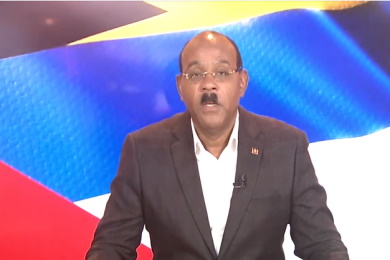
It is being held under the “Climate Impact on Human Mobility: A Global Call for Solutions” and Browne in a video presentation, said consequently, SIDS have had to borrow repeatedly to repair damaged infrastructure and restore economic losses.
“We do this repeatedly to keep our countries viable and to avert the possibility of our people becoming climate migrants, or refugees. SIDS suffer the greatest financial burden to climate change on a per capita basis, despite the fact that they contribute the least CO2 emissions globally, a mere 0.5 percent,” he told the Council.
“They are the greatest victims, not only because of unattended loss and damage to lives and livelihoods, but also because of the very existence of these countries is fatally endangered,” Browne said, questioning “why should citizens and residents of large polluting countries live in luxury while our peoples live in climate misery?
The Antigua and Barbuda Prime Minister said he has a particular objective at upcoming United Nations Climate Change Conference (COP28) to be held in Dubai from November 30 to December 12, to focus on the Loss and Damage Fund .
Browne said he had championed for the fund during Antigua and Barbuda’s chairmanship of the Alliance of Small Islands States (AOSIS) last year, recalling that at COP27, the world’s greatest polluters agreed that such a fund was important and decided to establish a transitional committee to make recommendations for consideration at COP28.
“As we approach COP28, we must insist that the loss and damage fund be made operational without any further delays. The fund must provide adequate financing to help SIDS withstand the seas as they rise, the winds as they increase in strength; and resources to rebuild when all our efforts to build resilience against climatic events fail.”
But Browne told the Council that the ultimate priority is the urgent reduction in emissions and the acceleration to renewables. It gets ready to host the Fourth International Conference on SIDS in May 2024.
“At SIDS4, we will continue to lead on climate issues, because tackling climate change provides an opportunity to consolidate and accelerate development gains, through cleaner air, improved public health and greater security for all.
“We have no excuse not to act and we collectively must act now. We have all the tools to answer the challenges posed by climate change, environmental pressures and biodiversity loss. But tools are of no use if we don’t use them. What is missing is the commitment to act and to act now,” Browne added.
He said what is also needed is more action, more ambition and more political will failing which, the world will have to contend with a proliferation of climate migrants and climate refugees in the near future and their attendant mobility.
The Antigua and Barbuda Prime Minister warned that climate change is no longer a distant issue for some, saying it is an existential threat to all of humanity.
“The rate in which the climate is changing should cause all to panic, engendering a strong global response. Every day the world faces new climate-related devastations, that have become more frequent and impactful. ”
Browne said that no country, no community, no one is immune and no one is safe until all are safe.
“Unfortunately, it is vulnerable small island states that continue to suffer disproportionately from the devastating consequences of climate change, despite their negligible emissions of green house gases. ”
Browne said annually, SIDS continue to face the unrelenting forces of tropical cyclones, prolonged droughts, sea level rise, ocean acidification and shifting weather patterns.
He said such events are becoming more frequent, more severe and will become even worse unless countries act urgently.
CMC/fg/ir/2023