
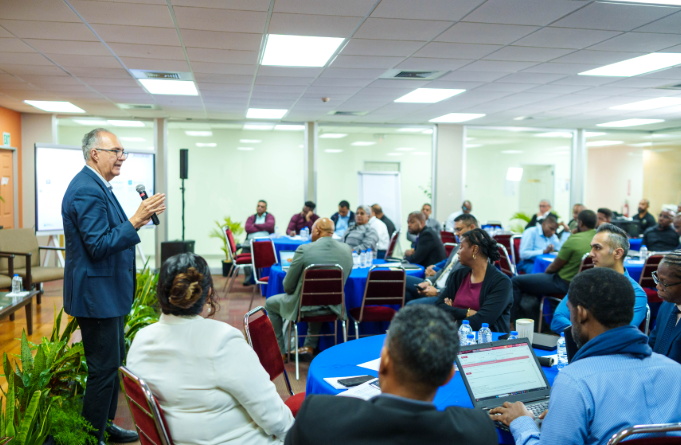
PORT OF SPAIN, Trinidad, Nov 6, CMC – The Singapore-based Access Partnership Institute (AP Institute) has brought Caribbean regulators and policymakers together for a two-day workshop on best practice in satellite policy and regulatory readiness.
For nearly three decades, AP Institute has worked with and through the International Telecommunications Union (ITU) to harmonise regulation and frequency access across administrations and industry, driving innovation for the benefit of humankind.
“This is where we do our best work,” said Lim May-Ann, Director of the Access Partnership Institute.
“By sharing what works and what doesn’t, we can help speed up access to transformational technologies. We are proud to partner with TATT and regulators from neighbouring states on this work.”
AP Institute, the global think tank that focuses on ensuring that emerging technologies advance humanity, by connecting innovators with policymakers, said the workshop held earlier this week formed part of Trinidad and Tobago’s Week of Spectrum organised by the Telecommunications Authority of Trinidad and Tobago (TATT).
The workshop was followed by the Caribbean Telecommunications Union’s (CTU) Spectrum Task Force.
A statement issued following the workshop said that the event was held amid rapid development of the international satellite ecosystem.
“New constellations, direct-to-device services, and advances in Earth observation are expanding what satellites can offer island and developing states. They can sustain economic growth, provide broadband through disasters, support trade and maritime safety, and reach remote and underserved communities. How the Caribbean authorises, coordinates, and plans for these services will shape who benefits,” according to the statement.
Juan Cacace, who leads Access Partnership’s Space and Connectivity practice, said “the promise of satellite has taken a long time to get to some of us. Regulators need the best regulatory tools to consolidate their advantages.”
The workshop covered the space ecosystem and orbital regimes, spectrum management for satellite services, satellite connectivity for universal access and digital inclusion, streamlined licensing frameworks and market access, and resilience and disaster readiness.
During the workshop, panelists highlighted the pivotal role of satellite technology in addressing the Caribbean’s unique geographic challenges by providing seamless coverage across isolated islands, mountainous terrain, and the vital maritime and aviation routes that sustain the region’s tourism, fishing, and transport sectors, satellites offer a highly effective infrastructural solution.
The panels noted that technological advancements continue to drive down costs, the panel underscored a critical reality: satellite connectivity serves as an indispensable lifeline for both disaster preparedness and the continuity of essential services.
“We were able to put the best commercial and regulatory thinkers in front of the region’s decision makers. We have a duty to make sure that what works best is available to all who want it, whether that is the best regulation or the best broadband service,” said Nicole Greene, a Trinidad-based adviser to Access Partnership.
CMC/jh/ir/2026