
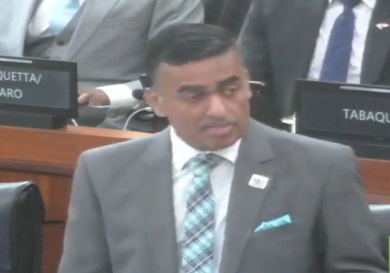
PORT OF SPAIN, Trinidad, Sept 1, CMC -Finance Minister Davendranath Tancoo has welcomed that the latest credit analysis of Trinidad and Tobago by the US-based rating agency, Moody’s, saying it is a further validation of the policy direction being undertaken by the government since coming to office in April last year.
“Our sizeable fiscal buffers, our renewed and continued access to international capital markets on favourable terms, and the encouraging outlook for our energy sector all point to a more stable and confident Trinidad and Tobago.
“We remain fully committed to deepening fiscal consolidation, strengthening our institutions, and building a stronger, more diversified economy for the benefit of all our citizens,” Tancoo said, adding that the analysis “reinforces the key conclusions reached by Moody’s in June 2026, when the agency revised the country’s outlook from “Negative” to “Stable” while affirming the Ba2 rating”.
According to Tancoo, Moody’s detailed credit analysis highlights Trinidad and Tobago’s sizeable fiscal buffers, improved near-term external profile and prospective gas-sector recovery.
He said that as an issuer in-depth report, the publication expands on the factors supporting and constraining the country’s credit profile.
Tancoo said Moody’s assessment considers Trinidad and Tobago’s economic strength, institutional and governance framework, fiscal position, liquidity, and susceptibility to external and other event risks.
He said the report highlights that Trinidad and Tobago’s credit profile is supported by sizeable fiscal buffers, including the Heritage and Stabilisation Fund, equivalent to approximately 25 per cent of gross domestic product (GDP, and Treasury cash and cash-equivalent deposits equivalent to a further seven per cent of GDP.
The Finance Minister said together, these assets provide meaningful capacity to absorb shocks, support budget financing and meet debt-service needs during periods of stress.
He said Moody’s also points to the country’s comparatively high-income levels (US$35,956.00 on a purchasing power parity basis in 2025), which continue to support economic resilience, and to a projected rebound in domestic gas production by the end of 2027 driven by the Manatee, Ginger and Aphrodite fields, expected to lift natural gas output from around 2.5 billion cubic feet per day to 3.0 – 3.5 by 2028-29, and support growth, exports and foreign-exchange generation over the medium-term.
Tancoo said Moody’s also recognised the strength of the country’s institutions, citing Trinidad and Tobago’s “constitutional system of checks and balances”, “clean political transitions”, and “strong voice and accountability” governance indicators, which the agency notes compare favourably with peers.
“The report further acknowledges the Government’s continued reform agenda, including an improved track record of data transparency, as well as reforms aimed at strengthening non-oil revenue and reducing the transfers and subsidies bill.
“On external buffers, Moody’s projects foreign-exchange reserves of US$3.5 – $4.0 billion, providing full external debt-service coverage and approximately four (4) months of import cover. It should be noted that actual reserves stood at US$5.7 billion in July 2026, corresponding to an import cover of 6.7 months; Moody’s uses a narrower metric, defined as liquid foreign-exchange reserves (gross reserves minus gold and SDR).”
Tancoo said that the agency also highlighted the country’s favourable external amortisation profile, extending to 2034, and noted that debt affordability remains in line with rating peers. In 2025, interest payments accounted for 12.7 per cent of government revenue, slightly below the regional median of 13.1 per cent.
Tancoo said access to a comparatively deep domestic financial market helps contain refinancing risks and interest costs, while foreign-currency debt represents a relatively small share of total government debt, limiting exposure to exchange-rate movements.
CMC/hg/ir/2026