
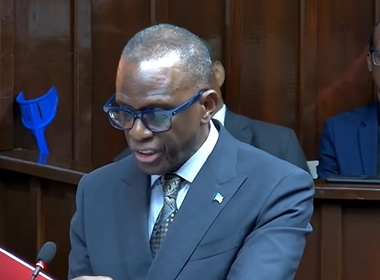
CASTRIES, St. Lucia, Apr 22, CMC – Prime Minister Phillip J. Pierre has presented an EC$2.19 billion (One EC dollar=US$0.37 cents) tax free budget to Parliament on Tuesday night, saying that barring any unforeseen circumstances “for which we have no control, we are expecting another current surplus and primary account surpluses continuing on the path of the last four years”.
Pierre in his three hour presentation, who defended the 2.5 per cent health and security levy introduced by his St. Lucia Labour Party (SLP) government in 2023, said no new taxes had been included in the fiscal package.
He told legislators that the loans and external financing for the budget will come from the various regional and international institutions including the Barbados-based Caribbean Development Bank (CDB), the European Investment Bank (EIB) the Canadian Clean Forest Climate Facility, the African Export Bank, as well as the Inter-American Development Bank (IDB), the World Bank, the Kuwait Fund for Economic Development, Taiwan and Saudi Arabia.
Pierre, who is also the Finance Minister, said that the uncertainty regarding the cost of oil on the world market will have a direct effect on the cost of fuel in St. Lucia, albeit a lag effect, and have far-reaching effects on every aspect of lives here.
“Our tourism, rising cost of electricity in St. Lucia, rising cost of food, and the cost of inputs for our agriculture industry, not to mention supply chain disruptions. This is why…I have been urging the people of St. Lucia to take responsibility for the things that are within their control and not allow themselves to be misled”.
Pierre noted that the returns on the health and security levy this year was estimated at EC$50 million dollars, while health and security expenses were nearly EC300 million.
Pierre said that since 2022, the government has provided the public and the private sector with a tax amnesty programme in the form of a waiver of all penalties and taxes due up to December 2023.
“Further, all taxes, interest and penalties due prior to the year 2000 have been written off.,” Pierre said, adding that an estimated 13,998 taxpayers have benefited from the existing tax amnesty programme.
He said approximately EC$100 million was collected and that the benefit to taxpayers was EC$357 million in interest and penalty relief.
Pierre said that after discussions with the private sector, the government has decided to continue the tax amnesty programme until December 31, 2027, but under agreed terms.
He said that all interest penalties and fines up to December 31, 2025, on all categories of taxes, will be waived and that a payment schedule must be arranged with the Inland Revenue Department by December 31 this year to settle all outstanding taxes.
“The payment schedule agreed upon must settle all outstanding taxes by December 31, 2027. Penalties, interest and fines will be liable on all taxes due after December 2027,” Pierre said, announcing other tax policies to be implemented.
He said the filing for company tax returns will be increased from three months to not more than five months ad that the usual quarterly payment schedules will remain.
“Decisions on all objections must be settled within 24 months. The Inland Revenue Department will be urged to be flexible with the taxpayer regarding payment arrangements for outstanding taxes.
“As soon as the necessary amendments have been enacted, all existing cumulative interest and penalties on outstanding taxes, currently at 12.5 per cent will be reduced to six per cent. Steps will be taken to ensure that the Tax Appeal Board is appointed and it will function adequately.”
Pierre told legislators that individuals will continue to file their income tax returns by March 31st and that for the first time, first-time landowners will have 50 per cent on the interest paid on their loans as a tax deductible amount.
“First-time landowners will be able to claim 50 percent of the interest of the loans that they have paid the bank or the financial institution for the land loan. This does not include the existing EC$40,000 allowance. So even though the first-time landowner does not meet the EC$40,000 allowance, he can still claim the 50 percent of the interest that they paid on their loan.”
Pierre said that the budget, presented under the theme “Consolidating Our Gains: Prospering in Uncertain Times,” will also provvide to all mothers of registered newborn babies, a one time grant of EC$1,000 effective August 1 this year.
“We will review parental leave provisions following childhood to better support families. We will review the Affiliation Maintenance Act. We will expand the school feeding programme to ensure greater nutritional support for students.”
Pierre said that a one-time payment in November this year, will be paid to every client on the public assistance programme. A one-time payment of EC$700 will also be paid to pensioners in November, an increase of EC$100.
He said under education and human capital development, he government will expand the mathematics master teacher’s programme to address learning deficits in numeracy.
The authorities will also introduce a master science teacher programme to strengthen science education nationally as well as strengthen and expand the truancy unit in collaboration with key stakeholders to both support and enforce school attendance.
The government will also move to improve the prosecution unit of the Royal St. Lucia Police Force by providing two annual scholarships in law for police officers over the next two years.
In addition, the government said it will review the economic cost programme for students pursuing law degrees and establish a national working group on universal early childhood education to guide policy and implementation.
“We will pay CXC (Caribbean Examinations Council) fees for five subjects for every solution. A grant of EC$250,000 to the Centre for Agricultural Development and Innovation of the Sir Alfred Lewis Community College to improve the agricultural units”.
Pierre said that the government will introduce additional tax rebate for businesses that provide after-school care for employees’ children.
“We will reduce the statutory interest on government transactions from six to four per cent. We will introduce a tax amnesty programme to waive the fines and penalties for late corporate filings at the company’s registry.
“We will implement sandbox legislation to support innovation in financial and digital services. We will undertake a comprehensive review of the Insolvency Act to address existing concerns. We will introduce tax credits for businesses donating to special education needs programmes. We will provide incentives for businesses engaged in plastic recycling and environmental sustainability.”
Pierre said that the government will also increase the allocation to the Youth Economy Agency, increase expenditure on tourism marketing and introduce an electronic single-entry window to improve the ease of doing business.
CMC/pr/ir/2026