
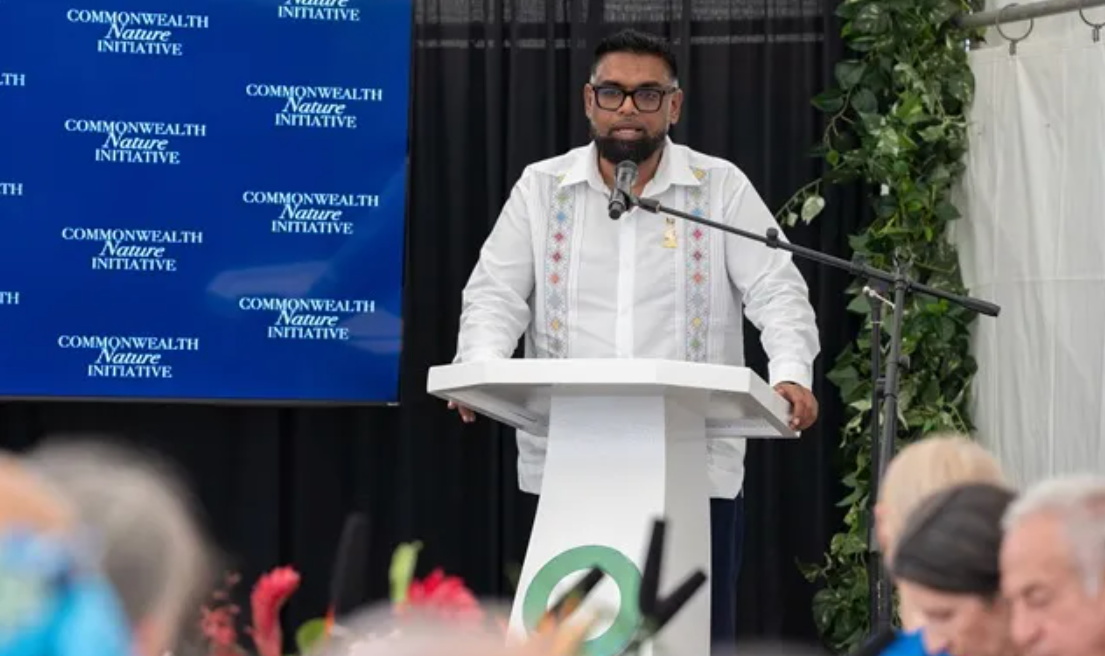
ST. JOHN’S, Antigua, Nov 4, CMC – Guyana’s President Irfaan Ali says the Commonwealth has an important role to play in biodiversity conservation, calling for greater partnerships and collaboration among member states.
Ali was among delegates attending the launch of the King Charles III-led Commonwealth Nature Initiative (CNI) held on the margins of the Commonwealth Heads of Government Meeting (CHOGM), that ends here later on Wednesday.
He said that 56 member Commonwealth should share a vision for greater collaboration among member states on biodiversity science, financing and knowledge sharing, urging the countries to transfer verbal commitments into tangible ones.
President Ali said that Commonwealth countries can take Guyana’s Low Carbon Development Strategy (LCDS) and its Global Biodiversity Alliance (GBA) agenda as examples on how environmental financing and conservation efforts can be mutually reinforced.
He said that transforming global biodiversity conservation from a largely discussion-based agenda into one driven by financing, implementation and development is practical once there is commitment and tangible support.
He said the CHOGM forum and the Commonwealth body are uniquely positioned to make the needed connections.
“His Majesty’s vision is not simply about protecting nature, but about creating opportunities for people and economies,” Ali said, highlighting the longstanding environmental leadership of British monarch.
President Ali said that discussions on biodiversity often remain disconnected from broader economic planning and development strategies.
“How do we ensure biodiversity is taken in that broader development conversation, where it is linked to economies, people, jobs, and opportunities?”
He suggested that for countries rich in forests and ecosystems, conservation efforts will only succeed on a sustained basis if communities and governments can realise tangible economic benefits from protecting natural resources.
He said conversations at recent biodiversity summits have increasingly focused on a key question of how the international community can move beyond declarations and commitments toward implementation.
The President noted that members of the Global Biodiversity Alliance have already begun exploring new approaches designed to place economic value on biodiversity services and create compensation mechanisms for countries that maintain ecosystems of global significance.
“At the GBA Summit in Georgetown, our members recognised that we must move beyond traditional approaches…. “That is why we engaged the private sector, philanthropy, and scientists to develop and advance new mechanisms that recognise the value of biodiversity services and compensate countries and protect ecosystems of global importance”.
The President disclosed that practical steps have already been agreed upon, including plans for an investment and finance forum expected to be held in London next year.
The CNI is a landmark international conservation effort launched with a US$202.2 million initial pledge to help middle- and low-income Commonwealth countries accelerate progress toward the global 30×30 target – conserving at least 30 per cent of the world’s lands and oceans by 2030.
CMC/hj/ir/2026