
By Linda Straker
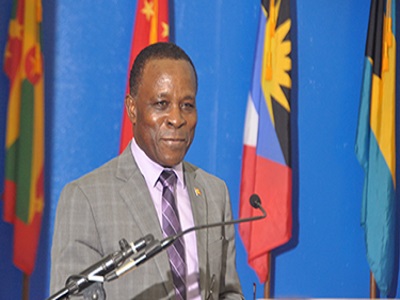
ST GEORGE’S, Grenada, Jun 18, CMC – Reinventing the economy of the Organization of Eastern Caribbean States (OECS), accelerating regional integration and building resilience are among Prime Minister Dr. Keith Mitchell’s key priorities for his chairmanship of the OECS Authority.
His term began Friday, on the 40th anniversary of the subregional body.
“What, therefore, should be our north star in the next year? It is simply to accelerate the process of regional integration to create a better quality of life for the people of the OECS,” Mitchell said in a virtual ceremony to mark the beginning of his chairmanship.
Outlining the priorities for his leg of the journey, Dr Mitchell, who is taking over from Dominica’s Prime Minister Roosevelt Skerrit said “accelerating regional integration” was high on the list.
“We must pick up the pace of this relay and, as we round this dangerous curve, we must recognize that our integration marathon is not simply about endurance but also speed,” he said.
The other priority areas are: reinventing the economy, valuing the environment, building resilience, and enabling equity and inclusion.
“The last four represent a matrix foundation which must be constructed as essential to the regional integration project,” said Mitchell.
“Infusing this approach will be cross-cutting themes that enrich the quality of the effort. Entrepreneurship, gender equity, digital innovation and the empowerment of youth are the interlinked strands which will make the process stronger, and the results better.”
Contending that in every situation of crisis there are seeds of opportunity which, if properly reaped, can yield transformational harvest, Dr Mitchell described the COVID-19 pandemic as one such case.
“The concurrent crises that have affected us have impacted the entire planet. They have also exposed many weaknesses of the global development model that requires transformation, and we have the opportunity as small island developing states to build to scale a greener, bluer, more inclusive, more resilient and more sustainable OECS. On this 40th Anniversary there is no better time for this recommitment,” he said.
“In the past 15 to 18 months, our region and, in fact, the world, has faced the worst nightmare imaginable. The COVID-19 pandemic crippled health care systems and caused millions of deaths around the world. Global trade was almost totally shut down.
“What we witnessed, sisters and brothers, was basically the cutting off at the knees of every inch of progress that we have painstakingly made against poverty, our efforts towards building resilience, and towards achieving the Sustainable Development Goals set out by the UN and subscribed to by us all,” he added.
The OECS Chairman said despite the challenges, the subregion had held its own.
“When we examine how far we have come and measure ourselves against the rest of humanity in this global storm, we have much to be proud of. In an environment in which there were no templates, no ready-made solutions; in a climate characterized by volatility, uncertainty, and complexity, we have emerged – in the words of Buju Banton – “buried alive… but still breathing… I don’t know what tomorrow may bring but I’ve got a feeling… there must be a reason’,” Mitchell said.
CMC/ls/ed/2021