
Access to archives and open data were the leitmotiv of the 10th quadrennial conference of Caribbean archives organised from December 2nd to 5th in Martinique by CARBICA, the association which brings together archivists from the English, French and Dutch-speaking Caribbean in close partnership with the departmental archives of Martinique.
In the presence of more than one hundred professionals from the Caribbean, local executives from Martinique and Guadeloupe, the issues of personal data protection, open government, the difficulties posed by the application of overlapping or deficient laws, the teaching of concrete examples from the Caribbean and the world over were exposed and debated by presenters from the fields of archiving, information and communication technology (ITC), public administration and university research. No fewer than 15 countries and territories were represented during the public conference on December 2nd , and during the training workshops which continued from December 3rd to 5th at the Departmental Archives of Martinique.
How to foster the growth of « a knowledge-based economy » while respecting the evolving framework, in Europe as well as the countries of the Caribbean, respect for private life and the right to information ? The public debate opened by this conference in Martinique, as well as the tools proposed during these training sessions, henceforth allow archivists to fully embrace the role they must play in access to information.
The interactive workshops, in French and English, facilitated by Trudy Peterson, specialist in questions of access and human rights (United States), Bruno Ricard, « Mr. Open data » of the inter-ministerial service of the archives of France (France), Avril Belfon (Trinidad and Tobago), Sharon Alexander-Gooding and Cherri-Ann Beckles (Barbados) who explored the legal framework in the English-speaking islands of the Caribbean and their impact on the archives, allowed participants to better position themselves with regards to problem-solving (identification of risks and possible recourse).
The 10th CARBICA conference, organised with the support of the General Council of Martinique, the Regional Cooperation Fund, the International Council of Archives, the French Ministry of Culture, the
Regional Council of Martinique, the General Council of Guadeloupe proposed a distinctive formula which guaranteed a mix of professions, thanks to a partnership with the National Centre for Territorial Public Service (CNFPT in French) and a combination of a public conference with practical professional work sessions.
The side events of CARBICA X also created a unique opportunity for regional cooperation:
– The Departmental Archives welcomed an intern from Barbados for an orientation programme in conservation and restoration techniques.
– Mrs. Silvia Ninita de Moura Estevao, of the National Archives of Brazil, met with high school students of Portuguese at the Bellevue High School.
– A mini-exhibition presenting an historical retrospective of Caribbean archival cooperation and presentation of Caribbean archives was set up in the lobby of the Departmental Archives.
The 10th conference of Caribbean Archives concluded with concrete resolutions in order to advance, with transparency and legal security, the opening of public archives to the citizenry : the Caribbean Archives Association, CARBICA, adopted the Principles of access to archives promoted by the International Council of Archives and committed itself to working towards them being taken into greater consideration in the legislations of the countries concerned. A summary of the current status will be quickly conducted, through an on-line questionnaire and the results will be published, as well as a selection of communications presented at the December 2nd conference. The CARBICA website will also enable sharing of procedures and forms developed by the archival services of the membership as useful documentary resources.
For further information, visit: www.carbica.org
CARBICA X in a few figures
94 participants at the conference held on December 2nd
16 countries and territories represented : Barbados, Belize, Bermuda, Brazil, Curacao, Grenada, Guadeloupe, Guyana, French Guiana, Haiti, Martinique, Saint-Martin, Suriname, Trinidad & Tobago, USA, metropolitan France.
3 workshops: « legislation and access to archives », « re-use of public data : new challenges », « implementation of principles of access », with 12, 19 and 34 participants respectively.
Photo captions:
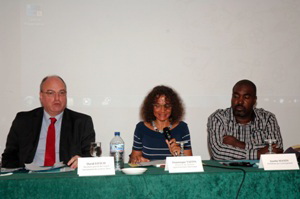
– Conference opening. From left to right : David Leitch, Secretary General of ICA, Dominique Taffin, Director of Departmental Archives and outgoing President of CARBICA, Jocelyn Régina, President of the Culture Commission of the General Council of Martinique.
– Attendance : in the foreground, Trudy Peterson, consulting archivist, Charles Gibson, Minister with responsibility for Public Services- Government of Belize.
CARBICA, a non-governmental organisation, branch of the international Council of Archives (ICA), aims to unify archivists of the Caribbean basin (including fringe countries on the continent washed by the Caribbean Sea such as Belize, Suriname, Guyana and French Guiana).
The organisation today includes more than 30 members, in 25 States and territories of the English, French and even Spanish- speaking Caribbean.
The objectives of CARBICA are :
– to serve as a forum for exchange of experiences among its membership
– to provide a broad range of training to often isolated archivists
– to contribute to the development of archival institutions and the promotion of the profession in a region where the relatively young States have only recently created such services ; develop awareness among public powers of the role of archives as a tool of governance, and cultural heritage.
The main project is the MIGAN project « Networking of Caribbean archives towards shared memory » : the setting-up of a portal for accessing historical resources stored in participating countries of the Caribbean basin. This project, associating 6 Caribbean partners, is supported by the European Union through the Interreg programme.